
Silicone Rubber | Condensation Cure | Base | Shore 20 | 1 kg
UFI: 3NA0-H0XU-T002-QH0N

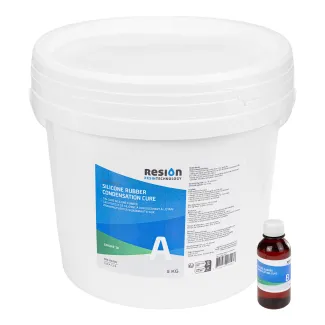
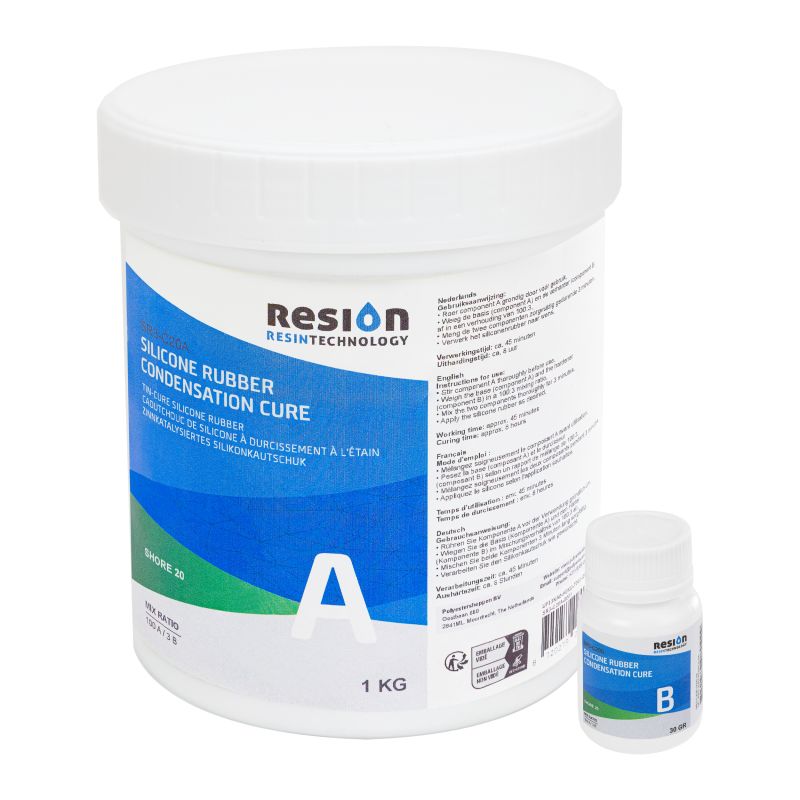
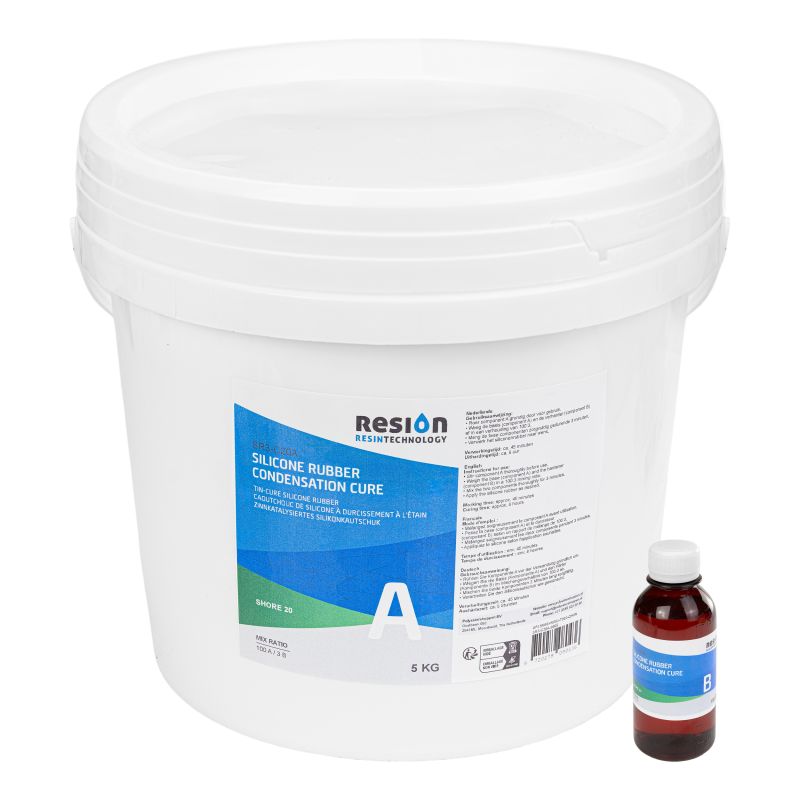
RESION Condensation Cure is a two-component, tin-catalysed RTV-2 silicone rubber. With a Shore A hardness of 20, this rubber produces soft, flexible moulds that make even complex shapes easy to demould. Thanks to its excellent reproduction of fine details and thermal stability, this product is an ideal choice for professional mould-making and casting applications using materials such as concrete, plaster and wax.
This silicone rubber is suitable for a wide range of applications, including:
For optimal properties, the cured mould can be post-cured in an oven at 150°C for 2-4 hours. This significantly improves tear resistance, dimensional accuracy and thermal stability.
| Pack size | Base (SR3-C20A) | Catalyst (SR3-C20B) |
| 1.03 kg set | 1 kg | 0.03 kg |
| 5.15 kg set | 5 kg | 0.15 kg |
| 10.3 kg set | 10 kg | 0.3 kg |
| 206 kg set | 200 kg | 6 kg |
The key technical properties clearly listed in one place.
The technical product category, such as primer, resin, hardener or cleaner. It explains the product's purpose and helps you find other products with a similar function.
Mixing ratio indicates how much of each component is needed, for example resin (A) and hardener (B). A ratio of 100:50 by weight means 100 grams of A to 50 grams of B; by volume you might use millilitres. Weight and volume ratios are not necessarily the same because the components may have different densities. Accurate measuring is important for proper curing.
Elongation at break indicates how much a material can stretch during a tensile test before it breaks. It is expressed as a percentage (%) of the original length. At 100% elongation, the material has doubled in length just before breaking. A high value indicates a high ability to deform, but not how much force is needed.
Tear strength describes the force needed to extend an existing tear in a material. For silicone rubber, this matters when a mould is frequently stretched during demoulding. The value is often expressed in N/mm (newtons per millimetre of specimen thickness) or kN/m. These units are equivalent: 1 N/mm = 1 kN/m = 1,000 N/m. Check the unit carefully: a value in N/m is therefore a thousand times smaller than the same number in N/mm. Specimen shape and test method also affect the result.
Tensile strength is the maximum tensile stress a material can withstand during a tensile test before failure. It is usually expressed in MPa (megapascals) or N/mm² (newtons per square millimetre); 1 MPa = 1 N/mm². Under comparable test conditions, a higher value means greater resistance to tension. In composites, fibre orientation also affects the result.
Curing time is the period a product needs to reach a specified stage of cure. It is usually given in hours or days, often at a reference temperature such as 20 °C. A product may be tack-free or safe to handle before reaching its full mechanical and chemical resistance. Film thickness and mixed quantity may also affect the time.
Working time is the period during which a product remains workable after mixing or activation, usually given in minutes at a specified temperature, often 20 °C. With reactive resins, the chemical reaction also continues in the mixing container, and larger quantities or higher temperatures can shorten this time. Working time is different from gel time and full curing time.
Food contact suitability means that a material may come into contact with food under specific, defined conditions. This suitability does not automatically extend to every application.
A fully cured or odourless product is not automatically food-safe. Check the manufacturer's declaration or technical documentation for the permitted use.
Heat resistance describes the temperature a material can withstand after correct processing and curing, usually expressed in degrees Celsius (°C). Continuous exposure is different from a brief temperature peak, and mechanical loading may also affect the limit. Heat resistance is not the same as the temperature at which the product can be applied.
Hardness describes a material's resistance to indentation. For silicone rubber and other elastomers, the Shore A scale is commonly used: Shore A 15, for example, is softer than Shore A 40. Harder plastics may be rated on the Shore D scale. The number belongs to its Shore scale and is not a unit like MPa; values on different scales cannot be directly compared.
Read the warnings and use appropriate protective equipment before handling the product.
UFI: 3NA0-H0XU-T002-QH0N
UFI: 76K0-20PS-R00M-XJ9A
Useful additions for your project.