
RESION AcryWeld Acrylic Adhesive
At a glance
- Bonding Acrylic
- Fast curing
- Low viscosity
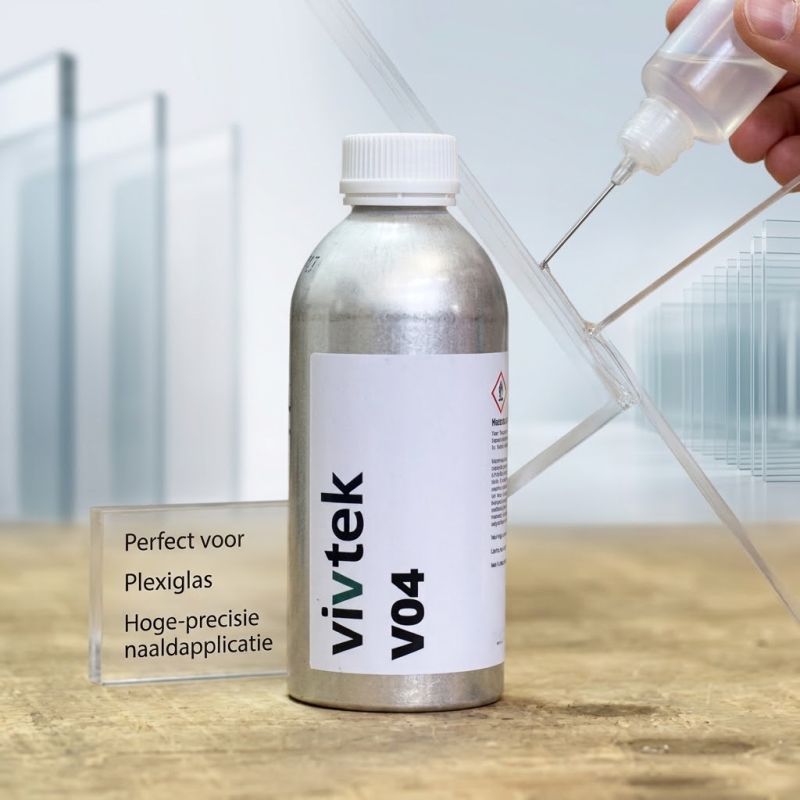
RESION AcryWeld is a transparent, extremely low-viscosity solvent-based adhesive designed for bonding acrylic (PMMA), polycarbonate (PC), and various other rigid plastics. Its low viscosity makes it particularly suitable for capillary bonding. For capillary bonding, the adhesive is applied along the bond line using a fine needle or dispensing applicator, allowing it to flow between the components through capillary action.
This product is a single-component adhesive and is therefore ready to use. No mixing is required. AcryWeld is a replacement for Weld-On 4SC and Vivtek 04.
Benefits of RESION AcryWeld
- Extremely low viscosity for capillary bonding.
- Transparent and colourless.
- Ready to use.
- Short working time of 1 to 2 minutes.
- Suitable for PMMA, PC, PS, and various other rigid plastics.
- Penetrates approximately 6 mm into the joint.
- Available in a 500 ml container.
Suitable for various plastics
RESION AcryWeld can be used for bonding:
- Acrylic (PMMA)
- Polycarbonate (PC)
- ABS
- Polystyrene (PS)
- PVC
- CAB
- PETG
The final bond strength may vary depending on the type of plastic and is also influenced by the surface condition and joint design. For unfamiliar materials or critical applications, always perform a test bond first.
Applications
AcryWeld is suitable for applications requiring a low-viscosity plastic adhesive and a clean bond line, such as:
- Acrylic tanks and structures.
- Displays and presentation stands.
- Advertising letters and signage.
- POS and POP materials.
- Transparent plastic structures.
- Plastic housings and profiles.
- Model making.
- Alurapid and Elkamet materials.
How to use RESION AcryWeld
Ensure that the surfaces to be bonded are clean, dry, and free from grease before starting.
- Position the components precisely against each other.
- Apply a small amount of adhesive along the bond line using a fine needle or dispensing applicator.
- Allow the adhesive to flow into the joint through capillary action.
- Wait a few seconds and gently press the components together.
-
Allow the bonded assembly to cure without applying any load.
Do not use more adhesive than necessary. Due to its very low viscosity, comparable to that of water, AcryWeld spreads easily throughout the bond line.
Specifications
Type: single-component adhesive
Colour: transparent / colourless
Viscosity: 0.42 mPa·s at 20 °C
Application temperature: 18 to 25 °C
Working time: 1–2 minutes
Initial setting time: approx. 3 minutes
80% of final bond strength: after approximately 72 hours
Full bond strength: after approximately 7 days
Shear strength after 24 hours: 14.0 MPa (measured on PMMA)
Shear strength after 7 days: 17.5 MPa (measured on PMMA)
Packaging: 500 ml
Product properties
The key technical properties clearly listed in one place.
- Article number
- LIJ001466
-
Adhesive type describes the family of adhesive or sealant, such as epoxy adhesive, (methyl)methacrylate adhesive, polyurethane adhesive or polymer sealant. Its chemistry affects processing, curing, flexibility and adhesion. Products of the same type may still differ, so check the suitable substrates and application instructions.
- Acrylaatlijm
-
This property lists the substrates on which an adhesive, resin or coating can achieve strong adhesion according to the product information. The result also depends on surface preparation.
- Cleaning and degreasing: removes dirt, oil and other substances that interfere with bonding.
- Sanding or roughening: can improve adhesion when suitable for the substrate.
- Primer: required or recommended for some surfaces.
Materials such as PE, PP and PTFE are difficult to bond with many conventional adhesives and may need a specialist adhesive or pretreatment. If in doubt, test adhesion on a small area.
- Plexiglas (PMMA), Polycarbonaat (PC), PVC, ABS, Polystyreen
-
Open time is the period during which an applied adhesive, sealant or mortar can still be assembled, positioned or adjusted. It is usually given in minutes under specified conditions, often around 20 or 23 °C. Open time generally starts at application and may differ from the working time after mixing.
- 1 tot 10 minuten
- Colour
- Transparant
-
The recommended application temperature range indicates the conditions under which the product can generally be applied and cured properly. Three temperatures matter:
- Air: the temperature in the workshop or outdoors.
- Substrate: the temperature of the surface being treated.
- Product: the temperature of the resin, adhesive or coating itself.
A cold substrate can cause condensation and affect adhesion. At higher temperatures, two-component products may react faster, reducing their working time. Check the dew point and follow the product instructions.
- 18-25 °C
-
Curing time is the period a product needs to reach a specified stage of cure. It is usually given in hours or days, often at a reference temperature such as 20 °C. A product may be tack-free or safe to handle before reaching its full mechanical and chemical resistance. Film thickness and mixed quantity may also affect the time.
- Approximately 3 minutes
- Net contents
- 500 ml
-
Working time is the period during which a product remains workable after mixing or activation, usually given in minutes at a specified temperature, often 20 °C. With reactive resins, the chemical reaction also continues in the mixing container, and larger quantities or higher temperatures can shorten this time. Working time is different from gel time and full curing time.
- Approximately 1-2 minutes
-
Viscosity measures how easily a liquid flows, or how thick it is. Dynamic viscosity is usually expressed in mPa·s (millipascal-seconds), sometimes in cP (centipoise); 1 mPa·s = 1 cP. A lower value usually means a more free-flowing liquid, while a higher value indicates a thicker product. Temperature and test method strongly affect the value. Note that mPa·s is different from MPa, which is used to express mechanical strength.
- 0.42 mPa·s (20 °C)
Safety information
Read the warnings and use appropriate protective equipment before handling the product.
Reviews
Frequently bought together
Useful additions for your project.