
Araldite 2020-1 Epoxy Adhesive
At a glance
- Glass and ceramic adhesive
- Transparent and UV-resistant
- Low viscosity
Not sure about your choice?
Want to know which Araldite adhesive you need? Use our selection tool!
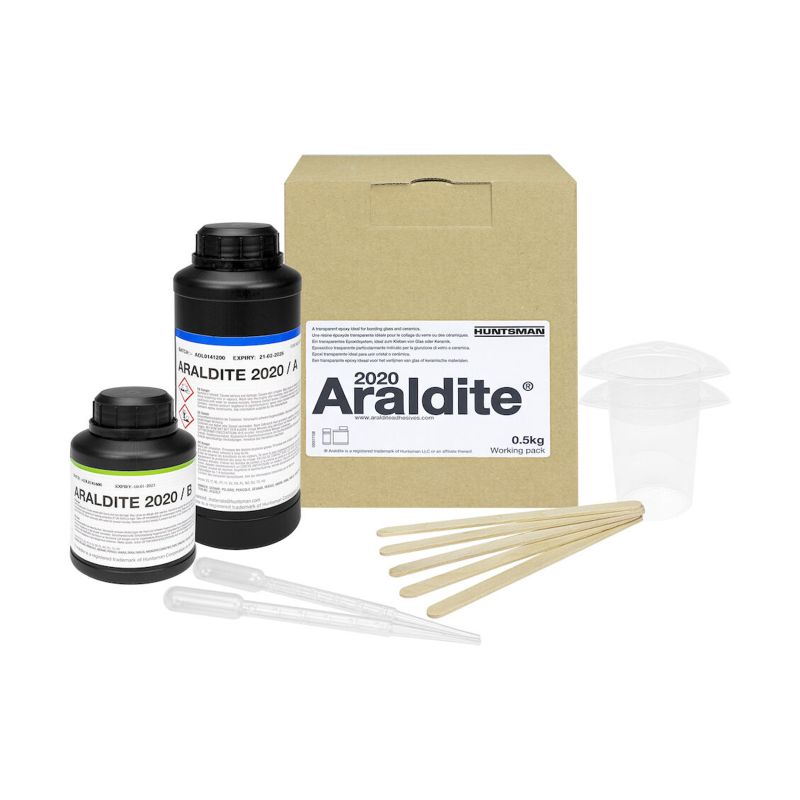
Araldite 2020-1 is a liquid, two-component epoxy adhesive that cures at room temperature. The adhesive is completely transparent and has a refractive index that closely matches that of glass. This makes Araldite 2020-1 a professional choice for the invisible bonding of glass and ceramics. Thanks to its very low viscosity, it is also ideally suited for clear castings (small volumes), component potting, and laminates.
Features of Araldite 2020-1 epoxy adhesive
- Particularly suitable for bonding glass and ceramics
- Transparent
- Long working time (approx. 160 minutes)
- Good chemical, temperature, and water resistance
Applications
Araldite 2020-1 is suitable for bonding the following materials:
- Ferrous metals and aluminium
- Glass, quartz, and gemstones
- Ceramics
- GRP (Glass Reinforced Plastic)
- CFRP (Carbon Fibre Reinforced Polymer)
- ABS
- PVC
- PC
- PMMA
Processing
Clean and thoroughly degrease the surfaces to be bonded. Carefully mix the measured components using the supplied spatula. While stirring, scrape the bottom and sides of the mixing cup to ensure a homogeneous mixture. Transfer the mixture to a clean cup and mix again. The adhesive is now ready for use. Apply the adhesive evenly to the bonding surfaces and press the parts together. Ensure the parts remain fixed in position for at least 16 hours.
The curing time can be significantly reduced by heating the adhesive to approximately 40 °C.
Specifications
Packaging: 0.5 kg (2-component pack)
Mixing ratio by weight: 100 parts A, 30 parts B
Mixing ratio by volume: 100 parts A, 35 parts B
Colour: transparent
Specific gravity: 1.1 g/cm3
Pot life: approx. 160 minutes
Time to reach 1 MPa strength: 16 hours (at 23 °C)
Time to reach 10 MPa strength: 25 hours (at 23 °C)
Optimum bond line thickness: 0.1 to 0.3 mm
Shear strength: 15 MPa
Tensile strength: 55 MPa
Peel strength: < 1 N/mm
Elongation at break: 11.9%
Temperature resistance: -60 °C to +80 °C
Product properties
The key technical properties clearly listed in one place.
- Article number
- LIJ000200
-
Adhesive type describes the family of adhesive or sealant, such as epoxy adhesive, (methyl)methacrylate adhesive, polyurethane adhesive or polymer sealant. Its chemistry affects processing, curing, flexibility and adhesion. Products of the same type may still differ, so check the suitable substrates and application instructions.
- Epoxylijm
- Colour
- Transparant
-
Open time is the period during which an applied adhesive, sealant or mortar can still be assembled, positioned or adjusted. It is usually given in minutes under specified conditions, often around 20 or 23 °C. Open time generally starts at application and may differ from the working time after mixing.
- 30 tot 60 minuten
-
Gap-filling capability describes how wide a gap or joint an adhesive or sealant can bridge, usually in millimetres (mm). The stated maximum is not necessarily the recommended adhesive layer thickness: a narrower joint may be needed to achieve good bond strength.
- tot 1mm (dunvloeibaar)
-
This property lists the substrates on which an adhesive, resin or coating can achieve strong adhesion according to the product information. The result also depends on surface preparation.
- Cleaning and degreasing: removes dirt, oil and other substances that interfere with bonding.
- Sanding or roughening: can improve adhesion when suitable for the substrate.
- Primer: required or recommended for some surfaces.
Materials such as PE, PP and PTFE are difficult to bond with many conventional adhesives and may need a specialist adhesive or pretreatment. If in doubt, test adhesion on a small area.
- Aluminium, Roestvast staal (RVS), Koper, Messing, Staal, Glas
-
Initial strength is the strength an adhesive joint develops shortly after the parts are joined. For some adhesives, the specification gives the time needed to reach a certain strength, for example 20 minutes to reach 1 N/mm² on aluminium at 23 °C. N/mm² (newtons per square millimetre) measures stress and is equivalent to MPa. The joint may not have reached its final strength at that point.
- Up to 1 MPa: 16 hours (23 °C)
-
Peel strength describes the force required to progressively separate an adhesive joint or tape by peeling the bonded parts apart. It is often expressed in N/mm: newtons per millimetre of bonded width. A higher value indicates greater resistance to peeling under the test conditions. Peel angle, substrate and test method affect the result. N/mm is not the same as N/mm².
- < 1 N/mm
-
Shear strength indicates how much stress a bonded joint can withstand when forces try to slide the joined parts parallel to the bond line. It is usually expressed in MPa (megapascals) or N/mm² (newtons per square millimetre): 1 MPa = 1 N/mm². A value of 20 MPa therefore represents a test stress of 20 N/mm². Substrate, overlap, adhesive thickness and test conditions affect the measured strength.
- 15 MPa
-
Density describes the mass of a material per unit volume. Values may be given in g/cm³, kg/L or kg/m³; 1 g/cm³ equals 1 kg/L. For example, one litre of a liquid with a density of 1.2 kg/L weighs approximately 1.2 kg. Density helps convert between weight and volume, but it can vary with temperature.
- 1.1 kg/L
-
Mixing ratio indicates how much of each component is needed, for example resin (A) and hardener (B). A ratio of 100:50 by weight means 100 grams of A to 50 grams of B; by volume you might use millilitres. Weight and volume ratios are not necessarily the same because the components may have different densities. Accurate measuring is important for proper curing.
- 100:30 (by weight), 100:33 (by volume)
-
Elongation at break indicates how much a material can stretch during a tensile test before it breaks. It is expressed as a percentage (%) of the original length. At 100% elongation, the material has doubled in length just before breaking. A high value indicates a high ability to deform, but not how much force is needed.
- 11.9%
-
Tensile strength is the maximum tensile stress a material can withstand during a tensile test before failure. It is usually expressed in MPa (megapascals) or N/mm² (newtons per square millimetre); 1 MPa = 1 N/mm². Under comparable test conditions, a higher value means greater resistance to tension. In composites, fibre orientation also affects the result.
- 55 MPa
- Net contents
- 0.5 kg (two-component pack)
-
Working time is the period during which a product remains workable after mixing or activation, usually given in minutes at a specified temperature, often 20 °C. With reactive resins, the chemical reaction also continues in the mixing container, and larger quantities or higher temperatures can shorten this time. Working time is different from gel time and full curing time.
- Approximately 160 minutes
-
Heat resistance describes the temperature a material can withstand after correct processing and curing, usually expressed in degrees Celsius (°C). Continuous exposure is different from a brief temperature peak, and mechanical loading may also affect the limit. Heat resistance is not the same as the temperature at which the product can be applied.
- -60 to 80 °C
Safety information
Read the warnings and use appropriate protective equipment before handling the product.
Reviews
Frequently bought together
Useful additions for your project.