
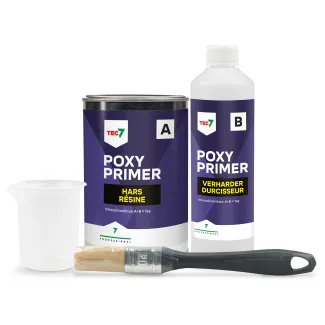
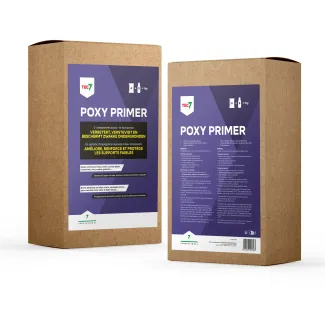
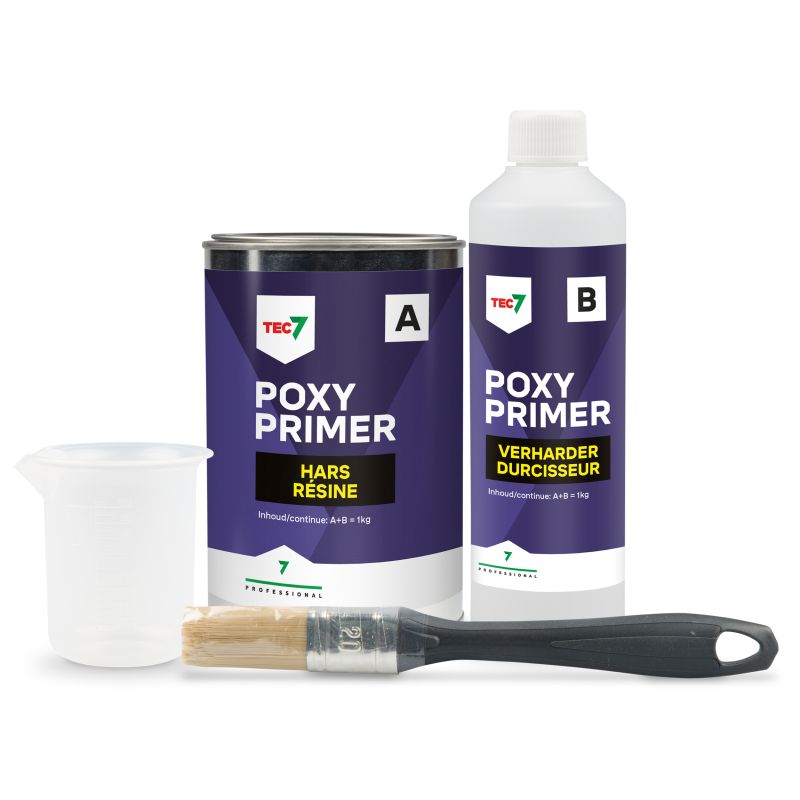
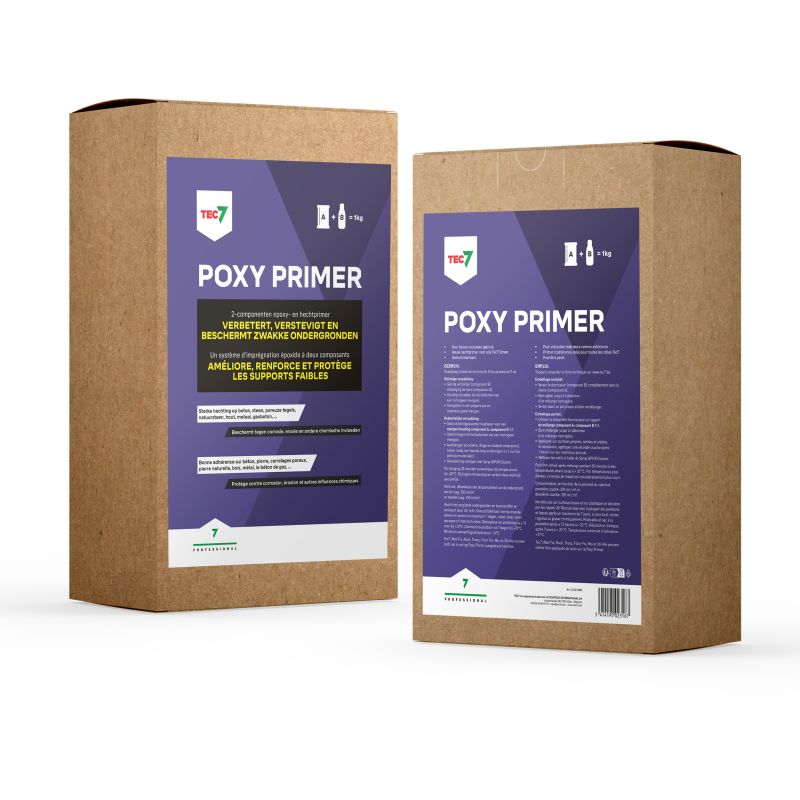
Tec7 Poxy Primer
At a glance
- 2-component epoxy primer
- Protects against corrosion
- Suitable for indoors and outdoors
Fast delivery throughout Europe
Secure payment with PayPal, Mastercard, Visa and more
4.7 out of 5 stars on Trusted Shops
Tec7 Poxy Primer is an epoxy primer for porous substrates. This 2-component epoxy adhesive primer is suitable for protecting and treating wood, stone and certain metals. Tec7 primer improves and reinforces substrates and penetrates directly into porous substrates.
Tec7 Poxy Primer is the ideal adhesive primer for bonding and sealing with Tec7 Adhesive Sealant, RTec7 Rock and Tec7 2K-Mix on porous substrates.
Benefits of Tec7 Poxy Primer
- Improves and reinforces weak and powdery substrates.
- High penetrating power in porous substrates.
- Protects iron against rust, fixes loose rust particles.
- Bonding primer for concrete rot repair.
- Suitable for indoor and outdoor use.
Directions for use
Tec7 Poxy Primer is easy to use. Follow the steps below for optimum results:
Preparation
- Minimum processing temperature: +5°C.
- Apply to a clean, completely dry surface.
- After mixing, workable for +/- 30 minutes at temperatures of +20°C. At high temperatures, the components can be cooled for a longer processing time.
Application
- Pour the hardener (Component B) completely into the resin (Component A), or use the measuring cup provided for a 1:1 mixing ratio.
- Mix very thoroughly until both components are completely mixed.
- After mixing, apply immediately with a brush or roller.
- On highly absorbent surfaces: apply a second coat after approximately 1 hour or longer.
- The Tec7 adhesives and sealants can be applied wet-on-wet on Poxy Primer.
- Protect from moisture and rain for 24 hours after application.
- Walkable and dust dry after approximately 12 hours at +20°C. Chemically resistant after 7 days at +20°C.
- Clean tools with Spray & PUR Cleaner.
- Can be painted over with most varnishes and paints.
Applications
- Concrete repair / corrosion protection: neutralises rust on rebar + bonding primer for Floor Fix / Wall Fix.
- Fixing of powdery surfaces for painting / bonding.
- Reinforcing weak substrates for bonding: cellular concrete, plaster, gypsum board, plasterboard, natural stone, weathered concrete, etc.
- Bonding primer for bonding on concrete, natural stone.
- Reinforcing façade bricks with suspended bonding under steel beams.
- Protects concrete and facade bricks against the effects of salts, manure, urine, etc.
Specifications
Colour: transparent, amber-coloured
Composition: epoxy resin and solvent
Viscosity: 450 mPa.s
Temperature resistance: -30°C to +60°C
Processing time: 30 minutes (20°C)
Drying time: 12 hours
Chemically loadable after: 7 days
Can be painted over: after max. 7 days
Coverage:
- First layer: 150 - 300 ml/m2
- Second layer: 250 ml/m2
For more technical properties, see the Technical documentation of Tec7 Poxy Primer.
Product properties
The key technical properties clearly listed in one place.
- Article number
- LIJ001438
-
The recommended application temperature range indicates the conditions under which the product can generally be applied and cured properly. Three temperatures matter:
- Air: the temperature in the workshop or outdoors.
- Substrate: the temperature of the surface being treated.
- Product: the temperature of the resin, adhesive or coating itself.
A cold substrate can cause condensation and affect adhesion. At higher temperatures, two-component products may react faster, reducing their working time. Check the dew point and follow the product instructions.
- 5-30 °C
-
The chemical base describes the chemistry of an adhesive, sealant, resin or coating, such as epoxy, polyester, polyurethane, (methyl)methacrylate or a hybrid polymer. It affects curing, flexibility and adhesion. Products with the same chemical base are not necessarily suitable for the same applications.
- epoxy resin
-
The period for which an unopened product remains usable under the specified storage conditions. Check whether the period starts from the manufacturing date or another date. Shelf life may be shorter after opening, especially for products sensitive to air or moisture.
- At least 12 months
-
The overcoating interval tells you when the next layer of paint, varnish or coating may be applied. Many multi-coat systems specify both a minimum and a maximum interval:
- Minimum overcoating time: the previous layer is dry or cured enough to accept another coat.
- Maximum overcoating time: the period during which the next coat can bond without extra surface preparation under the stated conditions.
Overcoating too early can affect drying or the finish. Once the maximum interval has passed, cleaning and sanding may be needed to ensure adhesion between coats. Temperature and film thickness affect the waiting times.
- At most 7 days
-
Working time is the period during which a product remains workable after mixing or activation, usually given in minutes at a specified temperature, often 20 °C. With reactive resins, the chemical reaction also continues in the mixing container, and larger quantities or higher temperatures can shorten this time. Working time is different from gel time and full curing time.
- Approximately 30 minutes (at 20 °C)
-
Viscosity measures how easily a liquid flows, or how thick it is. Dynamic viscosity is usually expressed in mPa·s (millipascal-seconds), sometimes in cP (centipoise); 1 mPa·s = 1 cP. A lower value usually means a more free-flowing liquid, while a higher value indicates a thicker product. Temperature and test method strongly affect the value. Note that mPa·s is different from MPa, which is used to express mechanical strength.
- 450 mPa·s
-
Heat resistance describes the temperature a material can withstand after correct processing and curing, usually expressed in degrees Celsius (°C). Continuous exposure is different from a brief temperature peak, and mechanical loading may also affect the limit. Heat resistance is not the same as the temperature at which the product can be applied.
- -30 to 60 °C
Reviews
Frequently bought together
Useful additions for your project.