Tec7 SprayTec Large Surfaces Starter Kit
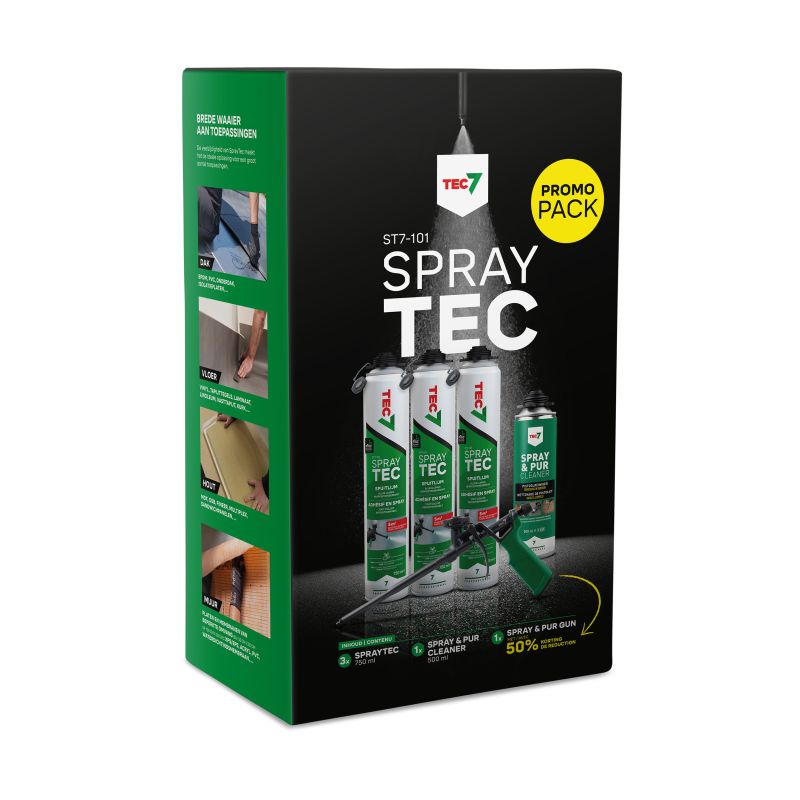
At a glance
- Includes cleaner and spray gun
- Suitable for large surfaces
- Compatible with all materials

Complete starter kit for bonding large surfaces with Tec7’s new SprayTec MS hybrid polymer adhesive. Thanks to its high bond strength of 15 kg/cm², fast-curing formula and repositionability, this kit is ideal for both professionals and DIY enthusiasts. One can of Tec7 SprayTec allows you to bond up to 5 m².
In addition to three cans of Tec7 SprayTec, the kit includes an application gun and a cleaner, so you can get started on your project straight away.
Benefits of the Tec7 SprayTec Large Surfaces Starter Kit
- Complete kit including cleaner and application gun.
- Bonds a wide variety of materials.
- Single-sided application.
- Repositionable.
- Suitable for slightly damp substrates.
Contents
| Product | Quantity |
| Tec7 SprayTec (750 ml) | 3x |
| Spray & PUR Cleaner | 1x |
| Spray & PUR Gun | 1x |
| Instructions | 1x |
Applications
The Tec7 SprayTec Starter Kit is suitable for bonding a wide range of construction materials over large surface areas, such as:
- Roofing materials: EPDM, PVC and roofing underlay.
- Floor coverings: linoleum, vinyl, LVT and cork.
- Walls and partitions: waterproofing membranes, insulation panels, shower panels and acoustic panels.
- Woodworking and lamination: veneer, HPL and bonding multiple panels together.
- Insulation materials: foam rubber, stair coverings, PIR, PUR, EPS and XPS.
Properties
SprayTec
Base: MS hybrid polymer
Curing mechanism: moisture curing
Colour: white
Initial tack build-up: 10-20 minutes
Skin formation: 30 minutes
Handling strength / functional strength: 4 hours
Curing: 24 hours
Adhesion strength: 15 kg/cm2
Processing temperature: +5 °C to +40 °C
Temperature resistance: -40 °C to +100 °C (short-term peak of +150 °C for a maximum of 30 minutes)
Adhesive layer thickness: 0.2-1 mm
Coverage: approximately 5 m² per can at an adhesive layer thickness of 0.25 mm
Paintable: with most common paints and coatings. Do not use with alkyd resin-based paints.
All values are measured at 23 °C and 50% relative humidity.
Spray & PUR Gun
Type: PU foam gun
Material: metal and plastic
Force transmission: adjustable
Drip stop: no
Force control: no
Number of settings: 50
Spray & PUR Cleaner
Appearance (at 20 °C): liquid
Vapour pressure (at 20 °C): ≥ 3000 hPa.
Vapour pressure (at 50 °C): ≥ 8000 hPa.
Relative density (at 20 °C): 0.79
Water solubility: soluble
Soluble in: ethanol, ether and chloroform
Relative vapour density: > 1
Product properties
The key technical properties clearly listed in one place.
- Article number
- LIJ002256
-
Adhesive type describes the family of adhesive or sealant, such as epoxy adhesive, (methyl)methacrylate adhesive, polyurethane adhesive or polymer sealant. Its chemistry affects processing, curing, flexibility and adhesion. Products of the same type may still differ, so check the suitable substrates and application instructions.
- Polymeerkit
-
The recommended application temperature range indicates the conditions under which the product can generally be applied and cured properly. Three temperatures matter:
- Air: the temperature in the workshop or outdoors.
- Substrate: the temperature of the surface being treated.
- Product: the temperature of the resin, adhesive or coating itself.
A cold substrate can cause condensation and affect adhesion. At higher temperatures, two-component products may react faster, reducing their working time. Check the dew point and follow the product instructions.
- 5-40 °C
-
The chemical base describes the chemistry of an adhesive, sealant, resin or coating, such as epoxy, polyester, polyurethane, (methyl)methacrylate or a hybrid polymer. It affects curing, flexibility and adhesion. Products with the same chemical base are not necessarily suitable for the same applications.
- MS hybrid polymer
-
The time after application during which a skin forms on the surface of a sealant. Tool the joint before the skin develops, as adjusting it afterwards can affect the finish or adhesion. Temperature and humidity influence this time.
- 30 minutes
-
The base material a product or part is made from, such as HDPE, aluminium, glass fibre or foam. Material choice affects weight, stiffness, chemical resistance and how the part can be worked or processed.
- Metal and plastic
-
The curing mechanism explains how a product develops its final strength or shape. The main mechanisms are:
- Two-component reaction (2K): a chemical reaction begins once components A and B are mixed. Mixing ratio and working time are important.
- Moisture curing (often 1K): the product reacts with moisture in the surrounding air. Temperature, humidity and film thickness affect the process.
- UV curing: light of the appropriate wavelength triggers the reaction. Areas that are not exposed to the light may not cure fully.
- Physical drying: water or solvent evaporates. This is different from chemical curing.
Some products use more than one mechanism, so the correct application conditions depend on the particular system.
- Moisture-curing
-
Consumption or coverage describes how much product is needed for a given surface area. Consumption may be stated in g/m² or kg/m², while coverage is often given in m²/L or m²/kg. A consumption of 0.2 kg/m² means a theoretical 200 grams per square metre. Actual use depends on film thickness, substrate absorbency, application method and waste.
- ± 5 m² per can (0.25 mm adhesive thickness)
-
Heat resistance describes the temperature a material can withstand after correct processing and curing, usually expressed in degrees Celsius (°C). Continuous exposure is different from a brief temperature peak, and mechanical loading may also affect the limit. Heat resistance is not the same as the temperature at which the product can be applied.
- -40 to 100 °C (short-term up to 150 °C; maximum 30 minutes)