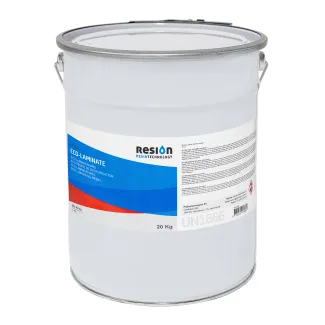
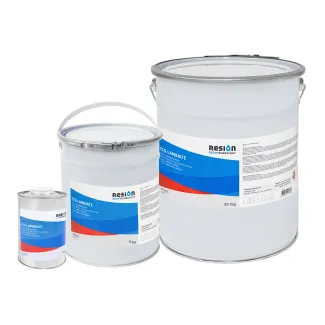
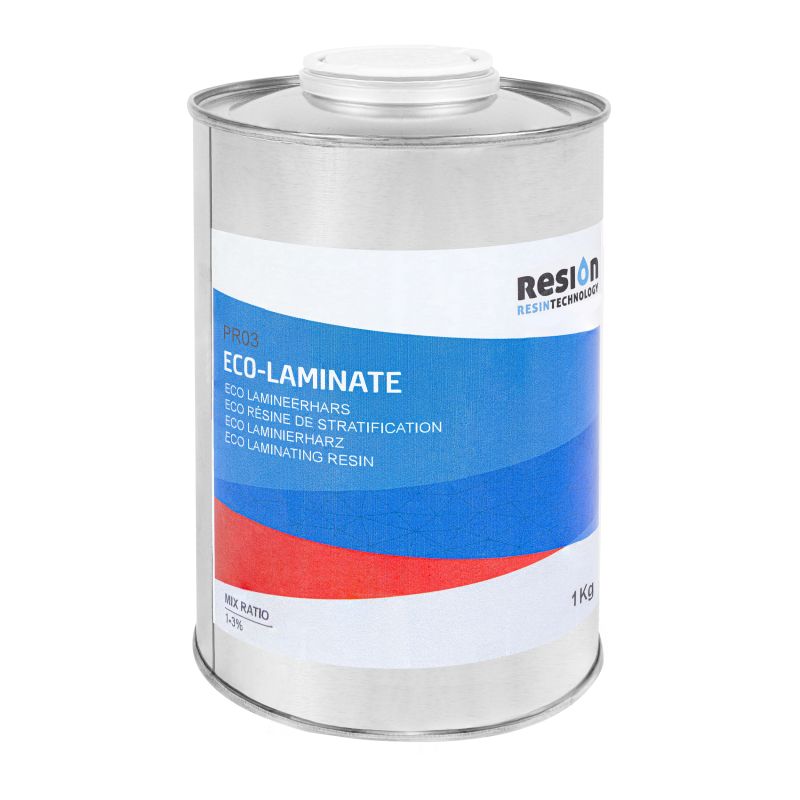
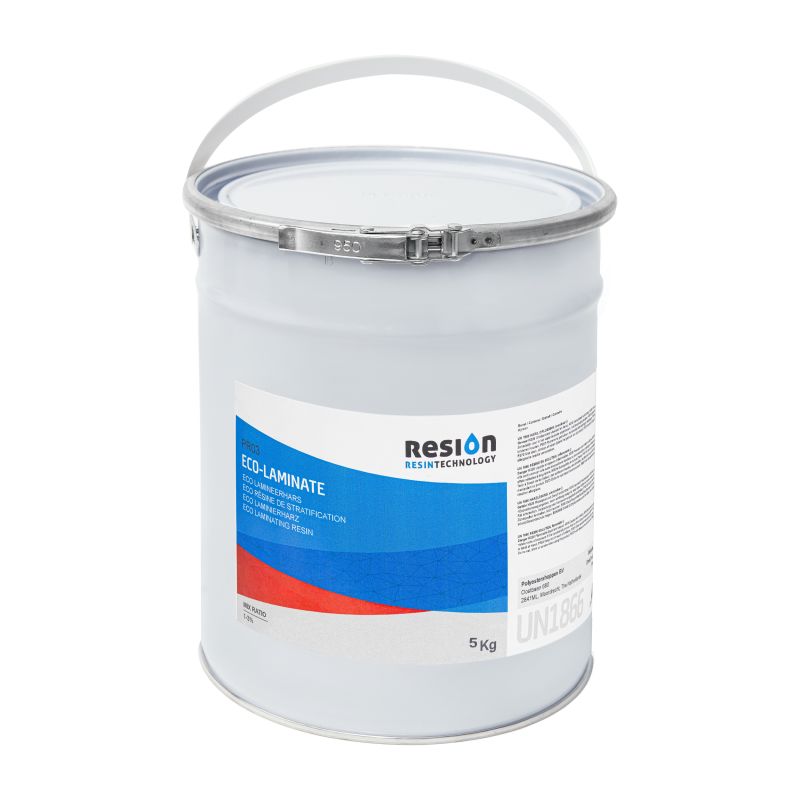
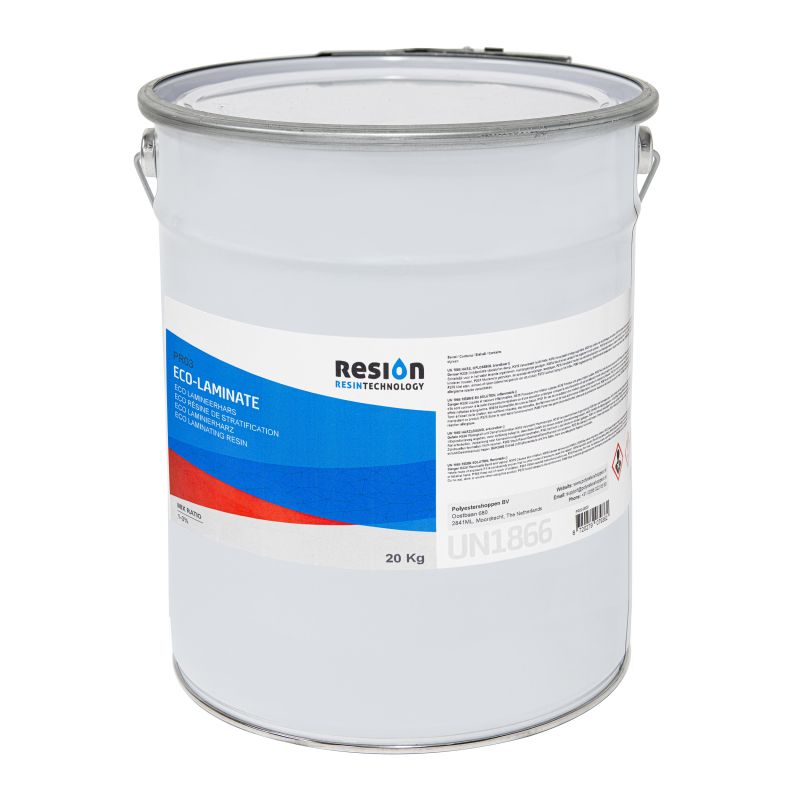
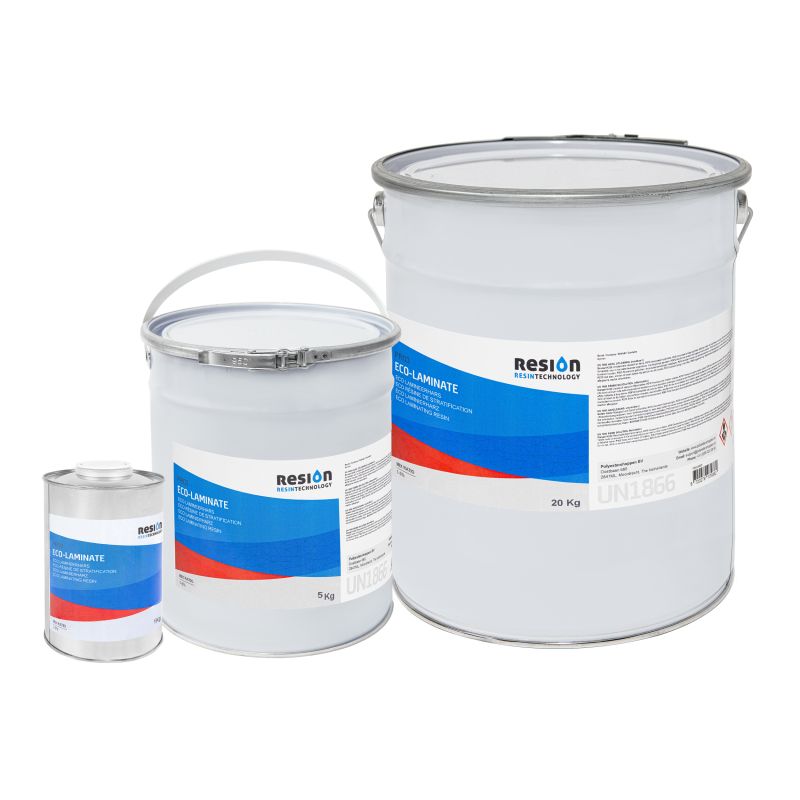

RESION Eco-Laminate Polyester Resin
At a glance
- Made from recycled PET
- 30 minutes processing time
- For processing with glass mat
Product description
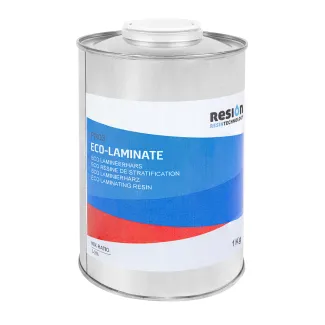
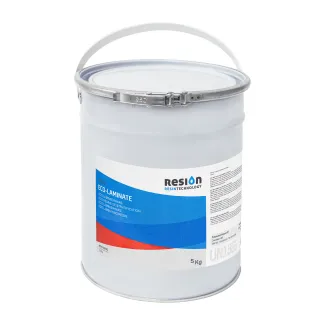
RESION Eco-Laminate is an innovative polyester laminating resin made from recycled PET bottles. The laminating resin also offers the same high-quality properties you are used to traditional polyester laminating resin.
Reasons to choose Eco-Laminate Polyester Resin
- Environmentally friendly polyester resin
RESION Eco-Laminate is made from recycled PET bottles, which makes this laminating resin an environmentally friendly choice. - Excellent quality
The laminating resin is just as strong, impact-resistant and reliable as traditional resins. - Versatile
Suitable for laminating in combination with glass fibre and suitable for materials such as wood and foam. The resin is suitable for use from 12°C.
Directions for use
Please follow the instructions below to apply this polyester laminating resin.
- Preparation: make sure the surface is clean, dry and dust-free.
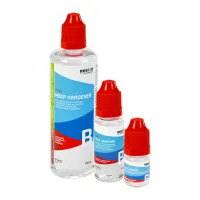
- Mixing: mix the resin with the correct amount of MEKP hardener (see the table below).
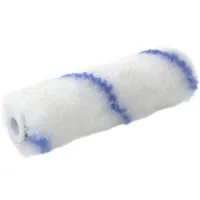
- Application: use a fleece roller or brush to apply the resin.
- Curing: let the resin cure for 4 to 6 hours. Cooler temperatures will slow down the cure rate.
How much hardener do you need?
The table below provides an overview of the required amount of hardener per quantity of laminating resin. You can easily order the hardener along with it!
| Hardener | |||
| 12-17 °C | 18-23 °C | 23-30 °C | |
| Resin (PR03): | 2.5% | 2% | 1.5% |
| 1 kg | 25 grams | 20 grams | 15 grams |
| 5 kg | 125 grams | 100 grams | 75 grams |
| 20 kg | 500 grams | 400 grams | 300 grams |
Product properties
The key technical properties clearly listed in one place.
- Article number
- POL002101
-
The technical product category, such as primer, resin, hardener or cleaner. It explains the product's purpose and helps you find other products with a similar function.
- Resin system
-
The tasks a product is intended for, such as laminating, casting, bonding, sealing or protecting. Products intended for the same application can differ considerably in processing, curing time and final properties.
- Laminate
-
Hardener type indicates which component or substance is needed to cure a resin, adhesive or coating. The mechanism varies with the chemical system:
- Epoxy: usually a specific compatible hardener (component B), mixed with the resin at the stated ratio.
- Polyester and vinyl ester: often an MEKP initiator that starts the curing reaction. Dosage is normally given as a percentage.
- Two-component polyurethane: uses a compatible second component, often based on isocyanates, as specified for the system.
Hardeners are not interchangeable. Use only the combination, dosage and safety precautions stated by the manufacturer.
- MEKP hardener
-
Curing time is the period a product needs to reach a specified stage of cure. It is usually given in hours or days, often at a reference temperature such as 20 °C. A product may be tack-free or safe to handle before reaching its full mechanical and chemical resistance. Film thickness and mixed quantity may also affect the time.
- Approximately 4-6 hours (20 °C)
- Net contents
- 1 kg, 20 kg, 5 kg
-
The application or processing methods specified by the manufacturer, such as brushing, rolling, spraying, casting or hand laminating. The chosen method can affect consumption, layer thickness and finish.
- Brush, Pile roller
-
Working time is the period during which a product remains workable after mixing or activation, usually given in minutes at a specified temperature, often 20 °C. With reactive resins, the chemical reaction also continues in the mixing container, and larger quantities or higher temperatures can shorten this time. Working time is different from gel time and full curing time.
- Approximately 20-24 minutes (at 20 °C)
-
Mixing ratio indicates how much of each component is needed, for example resin (A) and hardener (B). A ratio of 100:50 by weight means 100 grams of A to 50 grams of B; by volume you might use millilitres. Weight and volume ratios are not necessarily the same because the components may have different densities. Accurate measuring is important for proper curing.
- 100:2 (by weight)
Safety information
Read the warnings and use appropriate protective equipment before handling the product.
Reviews
Frequently bought together
Useful additions for your project.