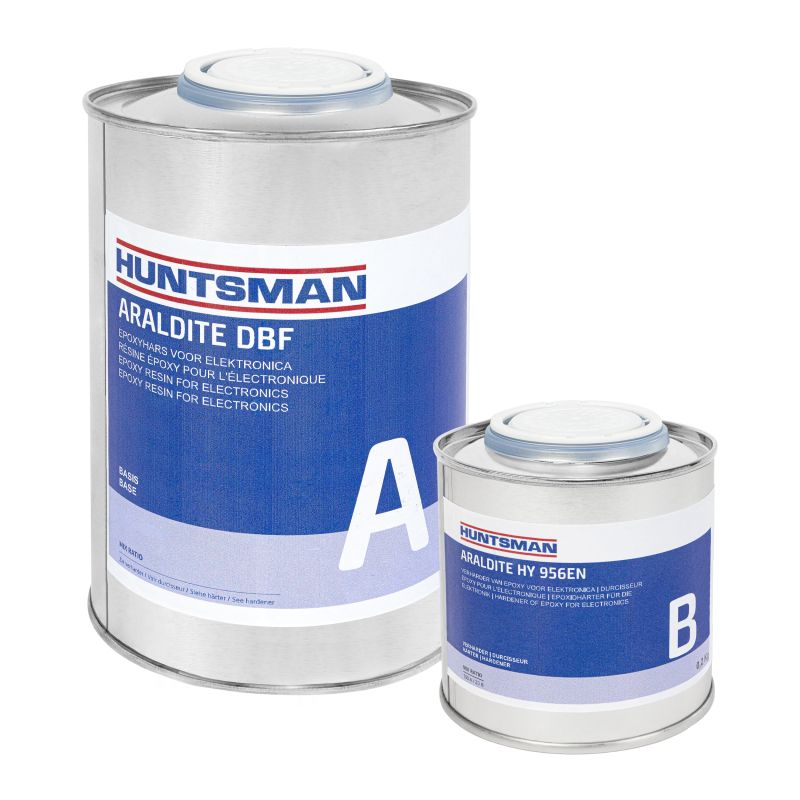

Araldite DBF | Epoxy giethars | 1 kg
UFI: QAQE-H0WQ-W00Y-UPPX-EP801-0001
Want to know which Araldite adhesive you need? Use our selection tool!
Araldite DBF with Aradur HY 956 EN is a low-viscosity epoxy casting resin for potting and encapsulating low-voltage and electronic components. Encapsulating electronic components in epoxy creates an electrically insulating layer that helps protect the components against external influences.
Once cured, the material has a dielectric strength of 24 kV/mm. This casting resin also offers good resistance to heat, atmospheric influences and chemical attack. Thanks to its low viscosity, the epoxy flows easily around components and into small gaps.
Araldite DBF / Aradur HY 956 EN has been developed for potting low-voltage and electronic components.
This process is also known as encapsulation, in which electronic components are fully or partially enclosed in a casting resin. After curing, the epoxy forms an electrically insulating layer around the components. For example, you can use this epoxy resin as a casting resin for junction boxes.
Would you like to pot electronics with an epoxy resin in the same colour as your finished product? You can colour Araldite DBF epoxy resin with RESION epoxy pigment. These pigments are available in all RAL colours.
Mix Araldite DBF epoxy resin with Aradur HY 956 EN hardener in the correct ratio:
| Contents | Araldite DBF (base) | Araldite Aradur HY 956 EN (hardener) |
| 1.2 kg | 1 kg | 200 g |
| 6 kg | 5 kg | 1 kg |
| 30 kg | 25 kg | 5 kg |
With epoxy casting resin from Polyestershoppen, you can encapsulate electronic components and protect them against external influences. Order your epoxy casting resin today before 17:00 CET and we will dispatch it today. Would you like more information about this casting resin for potting? We are happy to advise you. Contact us on +31 85 022 0090 or send an email to support@polyestershoppen.com. For other questions, please also visit our information centre.
The key technical properties clearly listed in one place.
Working time is the period during which a product remains workable after mixing or activation, usually given in minutes at a specified temperature, often 20 °C. With reactive resins, the chemical reaction also continues in the mixing container, and larger quantities or higher temperatures can shorten this time. Working time is different from gel time and full curing time.
Heat resistance describes the temperature a material can withstand after correct processing and curing, usually expressed in degrees Celsius (°C). Continuous exposure is different from a brief temperature peak, and mechanical loading may also affect the limit. Heat resistance is not the same as the temperature at which the product can be applied.
UV stabilisation helps a material better withstand the effects of sunlight, including yellowing and deterioration of its properties. It slows ageing but does not make a resin or plastic completely resistant to UV exposure. The degree of protection varies by product.
The technical product category, such as primer, resin, hardener or cleaner. It explains the product's purpose and helps you find other products with a similar function.
The tasks a product is intended for, such as laminating, casting, bonding, sealing or protecting. Products intended for the same application can differ considerably in processing, curing time and final properties.
Mixing ratio indicates how much of each component is needed, for example resin (A) and hardener (B). A ratio of 100:50 by weight means 100 grams of A to 50 grams of B; by volume you might use millilitres. Weight and volume ratios are not necessarily the same because the components may have different densities. Accurate measuring is important for proper curing.
Density describes the mass of a material per unit volume. Values may be given in g/cm³, kg/L or kg/m³; 1 g/cm³ equals 1 kg/L. For example, one litre of a liquid with a density of 1.2 kg/L weighs approximately 1.2 kg. Density helps convert between weight and volume, but it can vary with temperature.
Hardness describes a material's resistance to indentation. For silicone rubber and other elastomers, the Shore A scale is commonly used: Shore A 15, for example, is softer than Shore A 40. Harder plastics may be rated on the Shore D scale. The number belongs to its Shore scale and is not a unit like MPa; values on different scales cannot be directly compared.
Viscosity measures how easily a liquid flows, or how thick it is. Dynamic viscosity is usually expressed in mPa·s (millipascal-seconds), sometimes in cP (centipoise); 1 mPa·s = 1 cP. A lower value usually means a more free-flowing liquid, while a higher value indicates a thicker product. Temperature and test method strongly affect the value. Note that mPa·s is different from MPa, which is used to express mechanical strength.
Curing time is the period a product needs to reach a specified stage of cure. It is usually given in hours or days, often at a reference temperature such as 20 °C. A product may be tack-free or safe to handle before reaching its full mechanical and chemical resistance. Film thickness and mixed quantity may also affect the time.
Read the warnings and use appropriate protective equipment before handling the product.
UFI: QAQE-H0WQ-W00Y-UPPX-EP801-0001
Useful additions for your project.