Impermax Swimming Pool Coating 2K (Paintchlore)
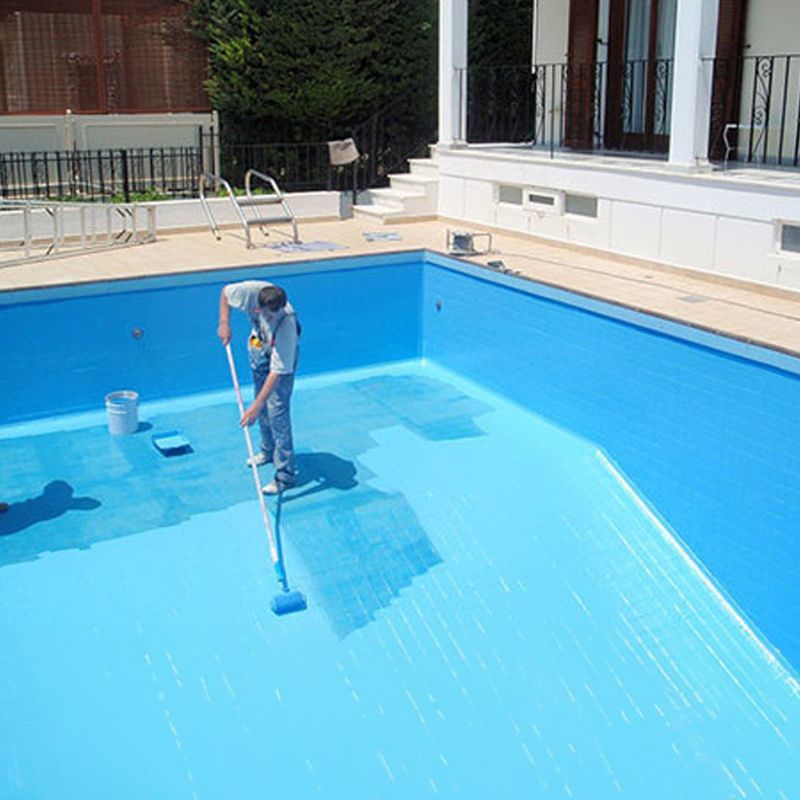
At a glance
- 2-component swimming pool coating
- Aliphatic polyurethane
- Excellent weather resistance

Impermax Paintchlore 2K is the ultimate protection for your swimming pool. This 2-component coating guarantees excellent weather and outdoor resistance with high-quality aliphatic polyurethane (PU). This way, your swimming pool surface is effortlessly resistant to yellowing and weather influences. The swimming pool coating is easy to use and has excellent adhesion to various surfaces. This way, as a professional or as a do-it-yourselfer, you can effortlessly apply the product to polyurea, concrete and polyester surfaces.
Therefore, choose the Impermax swimming pool coating and enjoy a beautiful and well-protected swimming pool for longer!
Features Impermax swimming pool coating
- Excellent weather and outdoors resistance.
- Stable to yellowing and chalking.
- Good resistance to chlorinated water (even in permanent immersion).
- Excellent mechanical properties.
- Good adhesion to different kinds of substrates.
Applications
This swimming pool coating from Impermax is suitable for applications in swimming pools with a polyurea, concrete and polyester substrate.
Preparation
Prepare the surface well to promote good adhesion. Ensure the surface is perfectly clean and free of dirt, dust, grease, or other contaminants.
Substrate preparation
- Application on polyurea
We recommend applying Paintchlore 2K (swimming pool coating) within a minimum of 2 hours and a maximum of 12 hours after spraying a new polyurea membrane. Are you going to apply the coating to existing polyurea substrates? Then first sand the surface to remove previous coatings and completely remove dust. Then treat the surface with Impermax Primer. - Application on cement/concrete:
Ensure that the concrete is completely dry (approximately 28 days). It is important to prime with epoxy to achieve a clean/sealed surface. With new concrete it is important to remove leachate and contaminants that can affect adhesion. We recommend using a diamond grinder or sandblasting equipment for a proper preparation process.
Directions for use
Follow the steps below to properly apply the swimming pool coating:
- Mix both components thoroughly in a 4:1 mixing ratio (20 kg component A, 5 kg component B).
- After mixing you have a processing time of approximately 5 hours at 20°C.
- Apply the coating crosswise in 2 layers of 200 grams/m² and let it harden.
- After approximately 8 hours the swimming pool coating is completely hardened and after at least 7 days it is water resistant.
Specifications
Contents: 25 kg (set)
Colour: blue (RAL 5015) or white (RAL 9010)
Gloss: high-gloss
Packaging: 20 kg A, 5 kg B
Mixing ratio: 4:1
Application method: air gun, brush or roller
Coverage: 200 g/m²
Pot life: 5 hours (at 20°C)
Touch dry after: 2 hours (at 10°C)
Fully cured after: 8 hours (at 10°C)
Water resistant: after 7 days minimum
VOC: 460 g/l
Primer: Impermax Primer
Thinner: Rayston PU Solvent
Product properties
The key technical properties clearly listed in one place.
- Article number
- VLO001793
-
Mixing ratio indicates how much of each component is needed, for example resin (A) and hardener (B). A ratio of 100:50 by weight means 100 grams of A to 50 grams of B; by volume you might use millilitres. Weight and volume ratios are not necessarily the same because the components may have different densities. Accurate measuring is important for proper curing.
- 4:1 (by weight)
-
A primer or suitable surface preparation helps the next product bond properly to the substrate. Different surfaces require different treatments:
- Porous substrates such as some concrete floors may need impregnation or priming to reduce absorption and bind loose dust.
- Non-porous or smooth substrates such as certain tiles may need sanding or a specialist adhesion primer.
- Metal and existing paintwork may require their own cleaning, sanding and priming system.
Remove dirt, grease and loose material. Also check the substrate's moisture level and whether the primer is suitable for both the substrate and finishing coat.
- Impermax Primer
-
Curing time is the period a product needs to reach a specified stage of cure. It is usually given in hours or days, often at a reference temperature such as 20 °C. A product may be tack-free or safe to handle before reaching its full mechanical and chemical resistance. Film thickness and mixed quantity may also affect the time.
- 2 hours (at 10 °C), 8 hours (10 °C)
-
Consumption or coverage describes how much product is needed for a given surface area. Consumption may be stated in g/m² or kg/m², while coverage is often given in m²/L or m²/kg. A consumption of 0.2 kg/m² means a theoretical 200 grams per square metre. Actual use depends on film thickness, substrate absorbency, application method and waste.
- 200 g/m²
-
A specific thinner that can be used, where permitted, to adjust a product's application properties or viscosity. The correct thinner and maximum quantity depend on the product. Incorrect thinning can affect coverage, drying and curing.
- Rayston PU Solvent
- Net contents
- 25 kg
-
The application or processing methods specified by the manufacturer, such as brushing, rolling, spraying, casting or hand laminating. The chosen method can affect consumption, layer thickness and finish.
- Brush, Spray, Velour roller
-
Working time is the period during which a product remains workable after mixing or activation, usually given in minutes at a specified temperature, often 20 °C. With reactive resins, the chemical reaction also continues in the mixing container, and larger quantities or higher temperatures can shorten this time. Working time is different from gel time and full curing time.
- Approximately 300 minutes (at 20 °C)
-
VOC content (volatile organic compounds) indicates the amount of these substances in a product, usually expressed in g/L (grams per litre). They may evaporate during application and drying. The value describes the composition, but actual exposure also depends on how much is used, ventilation and the application method.
- 460 g/l