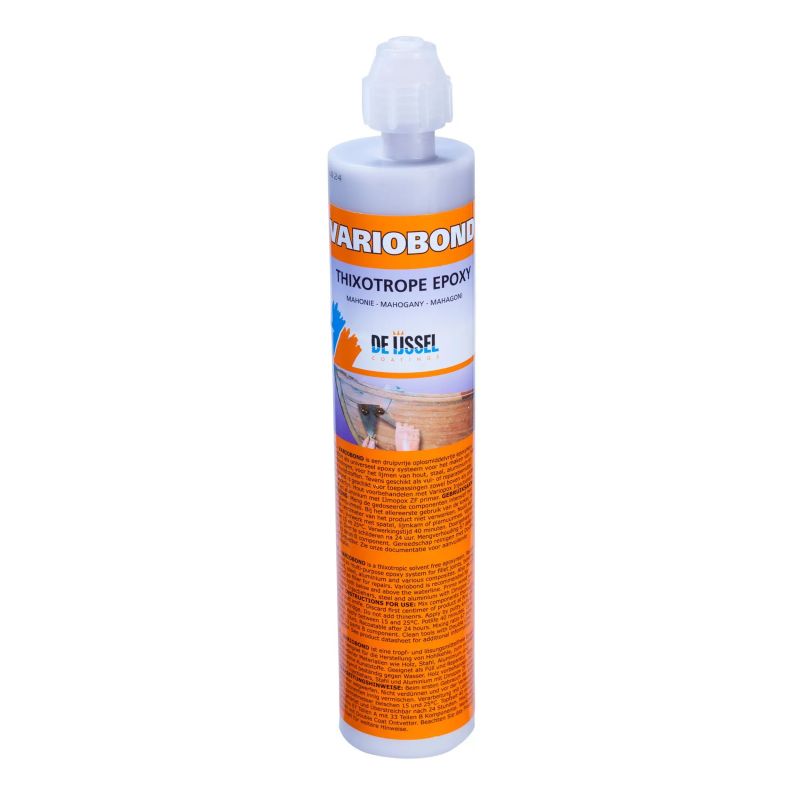
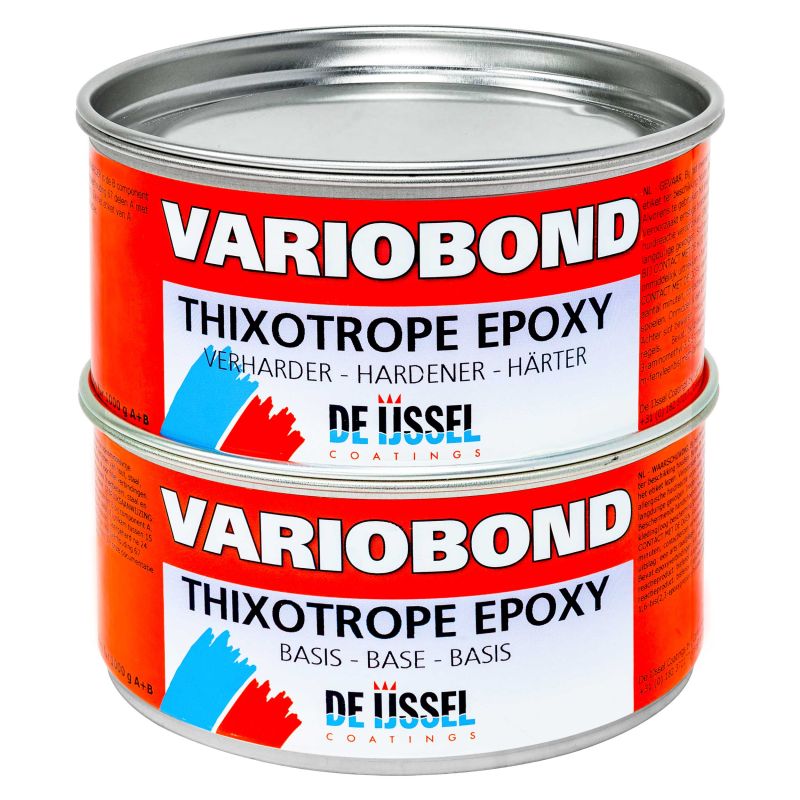

Variobond Epoxy adhesive
At a glance
- Strong and impact resistant epoxy
- Adhesion to many materials
- Easy to model
Product description
Two-component, non-sagging epoxy adhesive from Variobond. This epoxy adhesive can be used for bonding a wide range of materials, including wood, stone, aluminium, polyester, epoxy laminate and various plastics. It is also highly suitable for creating fillets (concave joints), filling holes, repairing wood rot and similar applications. The adhesive is also commonly used as an epoxy filler for wood rot.
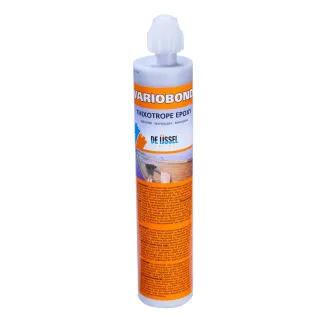
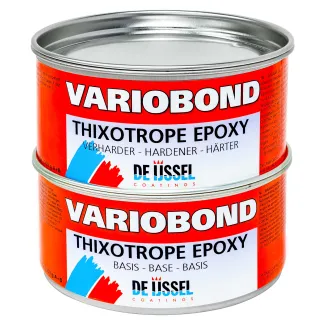
This adhesive is available in tins as well as convenient cartridges that can be used with a standard caulking gun. Each cartridge comes with 2 free mixing nozzles as standard.
Benefits of Variobond epoxy adhesive
- Contains no solvents.
- Excellent adhesion.
- Easy to apply.
- High water resistance.
Directions for use
Specifications
Packaging: 150 ml (cartridge), 1 kg, 7.5 kg
Colour: opal (1 kg, 7.5 kg) or mahogany (150 ml)
Mixing ratio: 2 parts base to 1 part hardener (by weight)
Coverage: approx. 1–3 m²/kg
Working time: 40 minutes at 20°C
Touch dry: after 24 hours
Overcoatable: after 24 hours
Fully cured: after 48 hours
Shelf life: at least 1 year in unopened packaging
Application gun: sealant gun 290-310 ml (for the 150 ml cartridge)
Mixing nozzle: mixing nozzle D (2 included as standard)
Product properties
The key technical properties clearly listed in one place.
- Article number
- EPO000176
-
Working time is the period during which a product remains workable after mixing or activation, usually given in minutes at a specified temperature, often 20 °C. With reactive resins, the chemical reaction also continues in the mixing container, and larger quantities or higher temperatures can shorten this time. Working time is different from gel time and full curing time.
- Approximately 40 minutes (at 20 °C)
-
Heat resistance describes the temperature a material can withstand after correct processing and curing, usually expressed in degrees Celsius (°C). Continuous exposure is different from a brief temperature peak, and mechanical loading may also affect the limit. Heat resistance is not the same as the temperature at which the product can be applied.
- Up to 50 degrees celcius
-
UV stabilisation helps a material better withstand the effects of sunlight, including yellowing and deterioration of its properties. It slows ageing but does not make a resin or plastic completely resistant to UV exposure. The degree of protection varies by product.
- Not applicable
-
The technical product category, such as primer, resin, hardener or cleaner. It explains the product's purpose and helps you find other products with a similar function.
- Epoxy system
- Colour
- Transparant / light yellow
-
The tasks a product is intended for, such as laminating, casting, bonding, sealing or protecting. Products intended for the same application can differ considerably in processing, curing time and final properties.
- Glue
-
Mixing ratio indicates how much of each component is needed, for example resin (A) and hardener (B). A ratio of 100:50 by weight means 100 grams of A to 50 grams of B; by volume you might use millilitres. Weight and volume ratios are not necessarily the same because the components may have different densities. Accurate measuring is important for proper curing.
- 2:1 (by weight)
-
The period for which an unopened product remains usable under the specified storage conditions. Check whether the period starts from the manufacturing date or another date. Shelf life may be shorter after opening, especially for products sensitive to air or moisture.
- At least 12 months
-
The overcoating interval tells you when the next layer of paint, varnish or coating may be applied. Many multi-coat systems specify both a minimum and a maximum interval:
- Minimum overcoating time: the previous layer is dry or cured enough to accept another coat.
- Maximum overcoating time: the period during which the next coat can bond without extra surface preparation under the stated conditions.
Overcoating too early can affect drying or the finish. Once the maximum interval has passed, cleaning and sanding may be needed to ensure adhesion between coats. Temperature and film thickness affect the waiting times.
- 1 day
-
A paint or varnish layer is dust-dry when settling dust is less likely to stick to the surface. It may not yet be touch-dry, ready for overcoating or suitable for loading; these are different stages of drying and curing.
- 1 day
-
Curing time is the period a product needs to reach a specified stage of cure. It is usually given in hours or days, often at a reference temperature such as 20 °C. A product may be tack-free or safe to handle before reaching its full mechanical and chemical resistance. Film thickness and mixed quantity may also affect the time.
- 2 days
-
Consumption or coverage describes how much product is needed for a given surface area. Consumption may be stated in g/m² or kg/m², while coverage is often given in m²/L or m²/kg. A consumption of 0.2 kg/m² means a theoretical 200 grams per square metre. Actual use depends on film thickness, substrate absorbency, application method and waste.
- Approximately 1-3 m²/kg
- Net contents
- 150 ml (cartridge), 1 kg, 7.5 kg
Safety information
Read the warnings and use appropriate protective equipment before handling the product.
Reviews
Frequently bought together
Useful additions for your project.