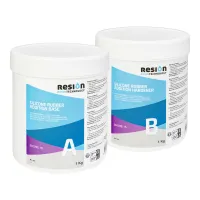
Silicone rubber for beginners is quite doable, as long as you keep to the mixing ratio, mix carefully and take enough time for curing. The biggest mistakes are not in the technique itself, but in impatience and sloppy weighing. Below you can read what to look out for, so that your first mould succeeds right away.
What makes silicone rubber so suitable for beginners
Silicone rubber for beginners is popular because the liquid material copies fine details exactly and stays flexible after curing. This lets you easily release a cast object from the mould, even with undercuts. The silicone rubber range is suitable in combination with epoxy, polyester, polyurethane, plaster and concrete, which means you can go in many directions with a single product.
What to look out for when choosing silicone rubber
When choosing silicone rubber, you mainly look at the hardness, the mixing ratio and the cure type. Together, these three determine how easy it is to work with and whether the result suits your project.
Choosing the right shore hardness
The shore hardness of silicone rubber indicates how soft or firm the mould becomes after curing. For lots of detail and shapes that are difficult to release, you choose a low shore such as silicone casting rubber shore 8. For resin art and general casting moulds, silicone casting rubber shore 15 is a commonly used first choice thanks to its low viscosity and ease of use.
A 1 to 1 mixing ratio is for starters
The mixing ratio determines how accurately you have to weigh. Platinum silicone you mix in a 1 to 1 ratio: equal parts base and hardener, which is the most user-friendly for beginners. Condensation cure silicone you work in a 100 to 3 ratio, so 3 percent hardener to the base, for which you need an accurate scale. As a starter, choose a 1 to 1 platinum variant, so that a small weighing error does not immediately disturb the curing.
Condensation cure or platinum cure
The cure type of silicone rubber determines the sensitivity to contamination and the lifespan of your mould. In the article on condensation cure and platinum cure you can read exactly what the difference is. In short, platinum cure silicones are more dimensionally stable and more sensitive to cure inhibition, while condensation cure silicones are more forgiving on contaminated surfaces.
Common mistakes you easily avoid
Most mistakes with silicone rubber arise during mixing and curing. They are easy to avoid if you know what to look out for.
Careless mixing and sticky spots
Careless mixing is the most common beginner's mistake with silicone rubber. Stir calmly but thoroughly and scrape along the edges and the bottom of the mixing cup, because that is exactly where unmixed material stays behind. If your rubber still stays sticky, that is almost always due to the ratio or to incomplete mixing.
Air bubbles in the mould
Air bubbles in the mould arise from mixing too fast or too roughly. So stir calmly, pour the mixture in a thin stream and give the material time to de-aerate. With very detailed moulds, extra attention to de-aeration is important; in this article you can read how to remove air bubbles from the surface.
Cure inhibition and non-curing rubber
Cure inhibition causes silicone rubber to not cure locally and stay tacky. This happens on contact with certain materials such as latex, modelling clay or surfaces that have not yet fully cured. In the article on cure inhibition you will find which substances cause this. A release agent on a porous surface helps prevent this problem in many cases.