Epifanes Epoxy Primer
At a glance
- Anti-corrosion epoxy primer
- Suitable for all substrates
- Good sandability
Fast delivery throughout Europe
Secure payment with PayPal, Mastercard, Visa and more
4.7 out of 5 stars on Trusted Shops
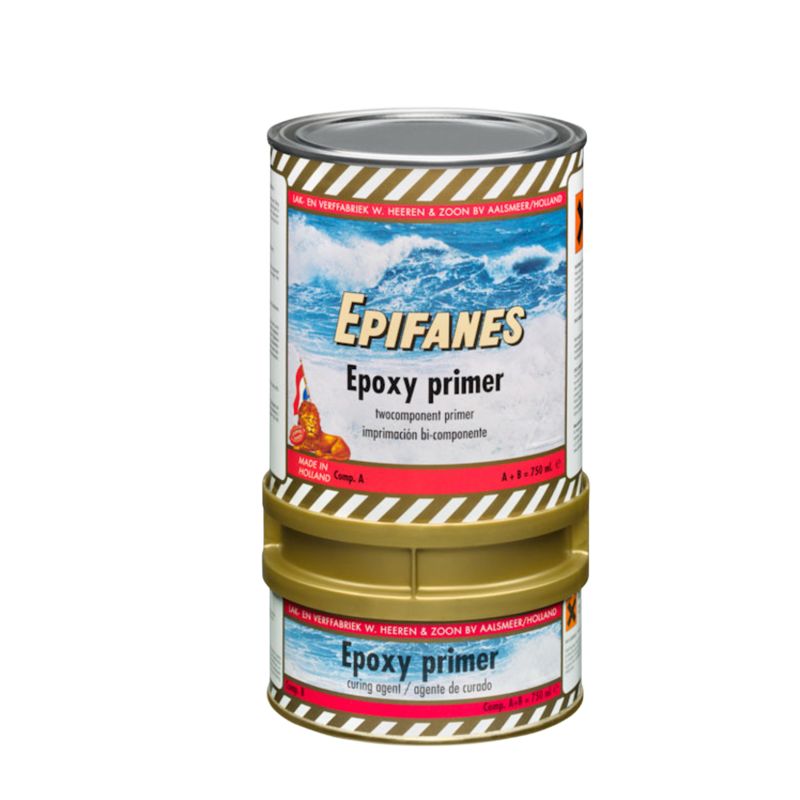
Epifanes Epoxy Primer is a two-component primer based on epoxy resin and zinc phosphate. The primer is renowned for its highly effective corrosion protection, excellent adhesion to a wide range of substrates, and high filling capacity. Thanks to its excellent sandability, it easily creates a smooth and even surface ready for subsequent finishing.
Features of Epifanes Epoxy Primer
- Anticorrosive epoxy primer (corrosion-inhibiting).
- High filling capacity.
- Suitable for use above and below the waterline.
- Excellent adhesion to wood, polyester, steel, and aluminum.
Application
This epoxy primer is suitable as a filling basecoat within a two-component system on wood (including hardwood) and polyester. On steel and aluminum, it can be used as a corrosion-inhibiting primer. Suitable for both interior and exterior use and can be applied above and below the waterline.
Directions for use
Follow the instructions below to apply Epifanes Epoxy Primer correctly:
- Prepare the substrate according to the technical documentation.
- Degrease and sand the substrate.
- Combine components A and B in a mixing container at a 100:25 volume ratio.
- Mix both components thoroughly and allow the mixture to rest for 15 minutes. Then stir again carefully, avoiding air entrapment.
- After mixing, add 5–10% Epifanes D-601 thinner if desired.
- Apply the epoxy primer with a brush, nylon roller or spray gun. Ensure sufficient film thickness to promote good flow.
- Do not apply the primer wet-on-wet, and avoid applying thicker layers than recommended to prevent sags and curing issues.
-
Allow the primer to cure for at least 6 hours before overcoating.
Note: if a subsequent layer of Epoxy Primer is applied within 5 days, sanding is not required. After 5 days, always sand with P120 before applying a new layer.
Specifications
Contents: 750 ml
Base: epoxy resin with dicalcium phosphate
Gloss: semi-gloss
Colour: white
VOC level: 439 gr/litre
Mixing ratio (volume): 100 parts component A + 25 parts component B (4:1)
Mixing ratio (weight): 100 parts component A + 14 parts component B
Pot life: 2-3 hours (at 20°C)
Induction time: 15 minutes
Recommended film thickness: 100 µm wet / 75 µm dry
Thinner: Epifanes D-601
Dust dry: 1 hour (at 20°C)
Recoatable: 6 hours (at 20°C)
Fully cured: 5 days (at 20°C)
Coverage: 10m2/l
Application temperature: 12°C - 28°C
Overcoatable (above the waterline): Epifanes Epoxy HB Coat, Epifanes Polyurethane Primer or Epifanes Polyurethane Yacht Paint
Overcoatable (below the waterline): Epifanes Epoxy HB Coat, Epifanes Interimcoat+
Product properties
The key technical properties clearly listed in one place.
- Article number
- LAK002323
-
The technical product category, such as primer, resin, hardener or cleaner. It explains the product's purpose and helps you find other products with a similar function.
- Primer
-
The recommended application temperature range indicates the conditions under which the product can generally be applied and cured properly. Three temperatures matter:
- Air: the temperature in the workshop or outdoors.
- Substrate: the temperature of the surface being treated.
- Product: the temperature of the resin, adhesive or coating itself.
A cold substrate can cause condensation and affect adhesion. At higher temperatures, two-component products may react faster, reducing their working time. Check the dew point and follow the product instructions.
- 12-28 °C
-
The chemical base describes the chemistry of an adhesive, sealant, resin or coating, such as epoxy, polyester, polyurethane, (methyl)methacrylate or a hybrid polymer. It affects curing, flexibility and adhesion. Products with the same chemical base are not necessarily suitable for the same applications.
- epoxy resin with dicalcium phosphate
-
Some two-component paints and coatings need to rest for a specified period after components A and B are mixed. This waiting period, known as induction time, allows the chemical reaction to begin before application.
If the induction time is 15 minutes, wait that long before applying the product. Induction time is not automatically additional working time: for many products, working time starts as soon as the components are mixed. Follow the sequence and timings in the product instructions.
- 15 minutes
-
Mixing ratio indicates how much of each component is needed, for example resin (A) and hardener (B). A ratio of 100:50 by weight means 100 grams of A to 50 grams of B; by volume you might use millilitres. Weight and volume ratios are not necessarily the same because the components may have different densities. Accurate measuring is important for proper curing.
- 100:14 (by weight), 4:1 (by volume)
-
The overcoating interval tells you when the next layer of paint, varnish or coating may be applied. Many multi-coat systems specify both a minimum and a maximum interval:
- Minimum overcoating time: the previous layer is dry or cured enough to accept another coat.
- Maximum overcoating time: the period during which the next coat can bond without extra surface preparation under the stated conditions.
Overcoating too early can affect drying or the finish. Once the maximum interval has passed, cleaning and sanding may be needed to ensure adhesion between coats. Temperature and film thickness affect the waiting times.
- 6 hours (20 °C)
-
A paint or varnish layer is dust-dry when settling dust is less likely to stick to the surface. It may not yet be touch-dry, ready for overcoating or suitable for loading; these are different stages of drying and curing.
- 1 hour (20 °C)
-
Consumption or coverage describes how much product is needed for a given surface area. Consumption may be stated in g/m² or kg/m², while coverage is often given in m²/L or m²/kg. A consumption of 0.2 kg/m² means a theoretical 200 grams per square metre. Actual use depends on film thickness, substrate absorbency, application method and waste.
- 10 m²/L
-
A specific thinner that can be used, where permitted, to adjust a product's application properties or viscosity. The correct thinner and maximum quantity depend on the product. Incorrect thinning can affect coverage, drying and curing.
- Epifanes D-601
- Net contents
- 750 ml
-
Working time is the period during which a product remains workable after mixing or activation, usually given in minutes at a specified temperature, often 20 °C. With reactive resins, the chemical reaction also continues in the mixing container, and larger quantities or higher temperatures can shorten this time. Working time is different from gel time and full curing time.
- Approximately 120-180 minutes (at 20 °C)
-
VOC content (volatile organic compounds) indicates the amount of these substances in a product, usually expressed in g/L (grams per litre). They may evaporate during application and drying. The value describes the composition, but actual exposure also depends on how much is used, ventilation and the application method.
- 439 g/L
Reviews
Frequently bought together
Useful additions for your project.
Often chosen

Recommended