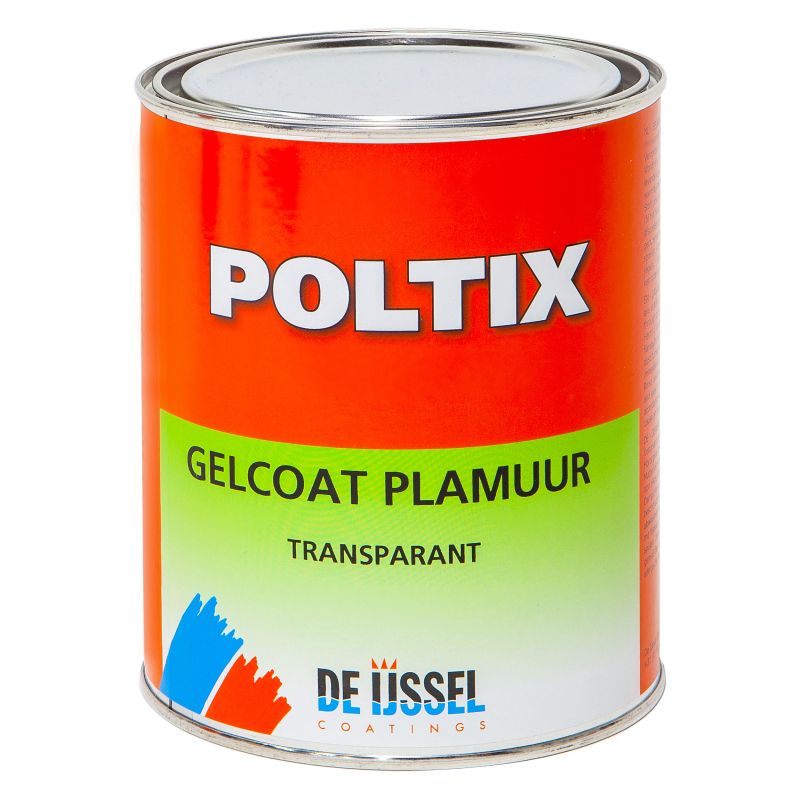

Poltix Gelcoat Repair Putty
At a glance
- Pasty, does not sag
- Can be coloured with pigments
- Fill deep holes in one go
Product description
Poltix repair putty is a thickened gelcoat designed for repairing dents, scratches and areas where the gelcoat is missing. The polyester filler is thick enough for application on vertical surfaces and even overhead. Poltix gelcoat repair putty is highly suitable for repairs to boats, horse trailers, washbasins, sanitary ware and more. Gelcoat filler is also known as liquid ceramic. Once cured, the gelcoat filler can be easily sanded and polished to a high-gloss finish.
How to process gelcoat repair putty
The liquid ceramic filler is best processed with a spatula or a putty rubber. We recommend working with small quantities at a time due to processing time. You can colour the polyester putty with any RAL colour polyester pigment to get the putty in the desired colour immediately.
To prepare the surface, sand it with sanding paper grain 120. After 60 minutes the gelcoat putty has cured sufficiently to be sanded and then polished or repainted with DD paint.
For minor repairs we also have a gelcoat repair kit in almost all RAL colours.
Benefits of Poltix Gelcoat Repair Putty
- For quick gelcoat repairs.
- Can be applied vertically or overhead.
- Can be mixed with polyester pigment in all RAL colours.
- Can be painted quickly.
- Can be polished immediately after curing.
Product properties
The key technical properties clearly listed in one place.
- Article number
- POL000039
-
The technical product category, such as primer, resin, hardener or cleaner. It explains the product's purpose and helps you find other products with a similar function.
- Putty
-
The tasks a product is intended for, such as laminating, casting, bonding, sealing or protecting. Products intended for the same application can differ considerably in processing, curing time and final properties.
- Putty
-
Dosage indicates how much additive, filler or auxiliary material is added to a base product. It is often given as a percentage (%), grams per kilogram (g/kg) or a ratio between components. Check whether the percentage is based on the resin, hardener or total mixture weight. Adding too much or too little can change the product's properties.
- MEKP hardener: 2%
-
A paint or varnish layer is dust-dry when settling dust is less likely to stick to the surface. It may not yet be touch-dry, ready for overcoating or suitable for loading; these are different stages of drying and curing.
- 15 minutes (remains slightly tacky)
-
Hardener type indicates which component or substance is needed to cure a resin, adhesive or coating. The mechanism varies with the chemical system:
- Epoxy: usually a specific compatible hardener (component B), mixed with the resin at the stated ratio.
- Polyester and vinyl ester: often an MEKP initiator that starts the curing reaction. Dosage is normally given as a percentage.
- Two-component polyurethane: uses a compatible second component, often based on isocyanates, as specified for the system.
Hardeners are not interchangeable. Use only the combination, dosage and safety precautions stated by the manufacturer.
- MEKP hardener
-
Curing time is the period a product needs to reach a specified stage of cure. It is usually given in hours or days, often at a reference temperature such as 20 °C. A product may be tack-free or safe to handle before reaching its full mechanical and chemical resistance. Film thickness and mixed quantity may also affect the time.
- 1 hour
- Net contents
- 1 kg
-
Working time is the period during which a product remains workable after mixing or activation, usually given in minutes at a specified temperature, often 20 °C. With reactive resins, the chemical reaction also continues in the mixing container, and larger quantities or higher temperatures can shorten this time. Working time is different from gel time and full curing time.
- Approximately 10 minutes (at 20 °C)
-
Gloss level indicates how much light a dry paint or coating reflects and how the finished surface looks.
- Matt: little reflection and a subdued appearance.
- Satin: a gentle sheen between matt and high gloss.
- High gloss: stronger reflections and a more pronounced colour, although surface imperfections may become more visible.
Gloss can be measured in gloss units (GU) at a specified angle. Terms such as matt and satin do not necessarily mean exactly the same thing across manufacturers. Substrate condition and application also affect the final appearance.
- Matte
- Colour
- Transparant
-
The overcoating interval tells you when the next layer of paint, varnish or coating may be applied. Many multi-coat systems specify both a minimum and a maximum interval:
- Minimum overcoating time: the previous layer is dry or cured enough to accept another coat.
- Maximum overcoating time: the period during which the next coat can bond without extra surface preparation under the stated conditions.
Overcoating too early can affect drying or the finish. Once the maximum interval has passed, cleaning and sanding may be needed to ensure adhesion between coats. Temperature and film thickness affect the waiting times.
- Approximately 1 hour
Safety information
Read the warnings and use appropriate protective equipment before handling the product.
Reviews
Frequently bought together
Useful additions for your project.