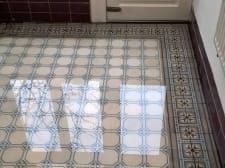

FS304 | EP Epoxy Coating Transparent | Basis | 5 kg
UFI: 1Q60-806K-Q009-9T6P
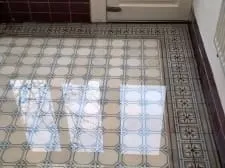
With this epoxy you can make a beautiful clear cast floor yourself. This system is perfect for creating a beautiful transparent floor coating. This allows you to preserve the appearance of the substrate, while benefiting from epoxy’s excellent mechanical strength and chemical resistance. As the name suggests, this epoxy floor coating is completely transparent. The epoxy system is UV-stabilised, making it resistant to yellowing. Combined with the right primer, the transparent floor coating can be applied to concrete, sand-cement, anhydrite, granite and tile floors, among others.
You can apply it in thin layers with a roller or, if you wish, pour it in thicker layers. The epoxy then levels out completely flat.
Clear floor coating is ideal if you want to keep the substrate visible, but are looking for additionale protection. It is therefore often used for the following applications:
This product has a working time of 60 to 90 minutes. Once applied, the epoxy is walkable after approximately 48 hours. This depends on the room temperature. After about 7 days, the coating is fully cured.
Clean the surface thoroughly by vacuuming and cleaning with ammonia and water. This will remove dirt and dust from the floor.
If necessary, use a suitable primer to improve the adhesion of the floor:
| Packaging | Yield as a coating | Yield as a cast floor |
| 7.5 kg | 30 m2 | 6 m2 |
| 15 kg | 60 m2 | 13 m2 |
| 30 kg | 120 m2 | 27 m2 |
You can leave the floor uncoated, but for better scratch resistance, we recommend finishing it with one of the following products:
For floors up to 15 m², DD paint can be applied. On larger floors, we recommend applying RESION Matt Floor Finish.
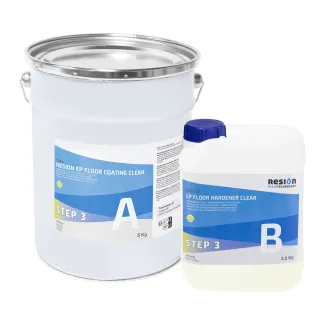
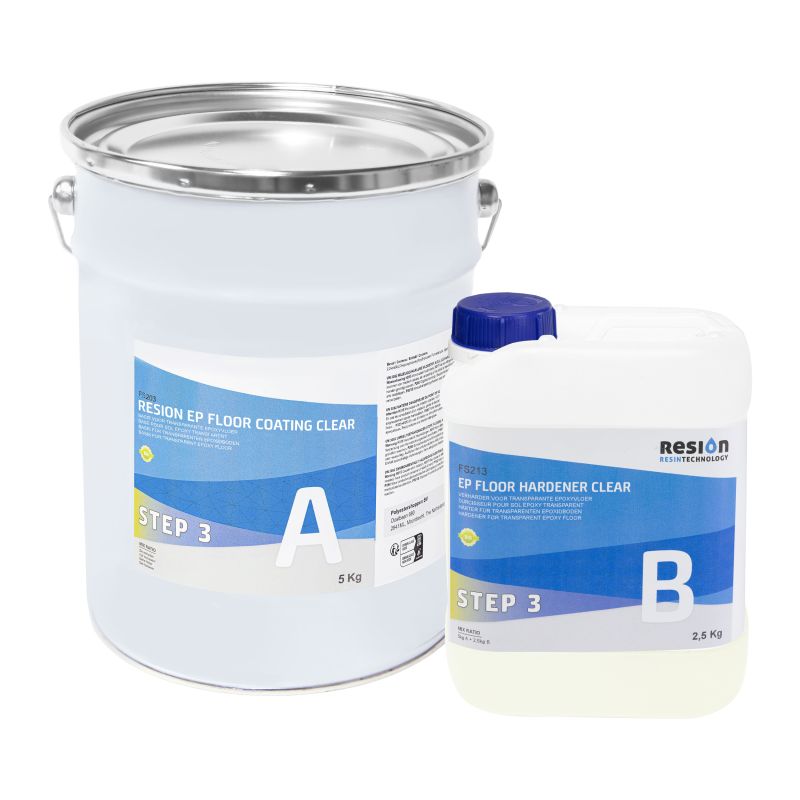
| Set | Base (FS304) | Hardener (FS314) |
| 7.5 kg | 5 kg | 2.5 kg |
| 15 kg | 10 kg | 5 kg |
| 30 kg | 20 kg | 10 kg |
The key technical properties clearly listed in one place.
The resin family or system that a hardener, additive or reinforcement material can be combined with, such as epoxy, polyester or vinyl ester. Compatibility depends on the complete system, not just the general resin type.
Minimum application temperature is the lowest temperature at which a product may be used according to the manufacturer. The limit can apply to the air, substrate and product itself.
At lower temperatures, resins and coatings can become thicker and cure more slowly. Moisture can also condense on a cold substrate and reduce adhesion. Check the dew point and measure the surface temperature before starting. A longer drying time does not automatically make application below the specified minimum acceptable.
The waiting time before a coating, floor or bonded joint can withstand a specified load, such as light foot traffic or gentle handling. Resistance often increases as curing continues; full mechanical and chemical resistance may be reached later.
Curing time is the period a product needs to reach a specified stage of cure. It is usually given in hours or days, often at a reference temperature such as 20 °C. A product may be tack-free or safe to handle before reaching its full mechanical and chemical resistance. Film thickness and mixed quantity may also affect the time.
Working time is the period during which a product remains workable after mixing or activation, usually given in minutes at a specified temperature, often 20 °C. With reactive resins, the chemical reaction also continues in the mixing container, and larger quantities or higher temperatures can shorten this time. Working time is different from gel time and full curing time.
Read the warnings and use appropriate protective equipment before handling the product.
UFI: 1Q60-806K-Q009-9T6P
UFI: VV60-80KD-A009-MGCT
Useful additions for your project.