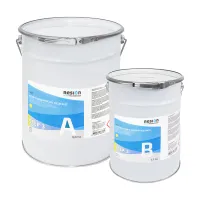
Is your cast resin floor still sticky, do you have dents in the surface, or are you experiencing other issues when applying an epoxy, PU, or polyaspartic floor system? Check here for solutions to the most common problems. We have clearly summarised the problem, its cause, and the solution in an easy-to-read table.
Common problems with floor primers (STEP 1)
| Problem | Cause | Solution |
| 1. The primer lifts from the substrate.
|
a. Greasy floor. b. Trowelled floor. c. Incorrect floor primer.
|
a. Ensure the floor is clean and, if necessary, degreased. Use RESION WB Epoxy Floor Primer for proper coverage. b. Use RESION WB Epoxy Floor Primer on trowelled floors. c. Use RESION WB Epoxy Floor Primer on smooth and trowelled floors. If the primer has already cured, sand it down and apply a second coat, or take photos and send them to our product specialists for evaluation. In certain cases, a cast resin floor can be applied on lifted primer, but this is at the discretion of the product specialist. |
| 2. The primer does not harden.
|
a. Not enough waiting time. b. Incorrect mixing ratio. |
a. The primer is usually sufficiently cured the next day to continue work. However, note that cold nights may extend the curing time. b. Check that the correct amounts of base and hardener have been properly mixed. Refer to the check page in the provided manual. If an incorrect ratio was used, the primer will not cure and must be removed. |
| 3. The primer has soft spots.
|
a. Not mixed properly. b. The tin was scraped empty or material leaked onto the floor. |
a. Ensure both components are thoroughly mixed, including the sides and bottom of the tin. “Mixing streaks” may appear during mixing; continue mixing until these disappear and then mix for at least 2 more minutes. b. Do not scrape tins completely empty and avoid spills on the floor. There will always be a small amount of unmixed material along the sides and bottom of the tin; this must not end up on the floor. Empty the tin fully and dispose of any remaining material properly. Clean soft spots with acetone and apply a new layer of primer. |
Common problems with levelling or scratch coat (STEP 2)
| Problem | Cause | Solution |
| 1. Powder is difficult to mix with other components.
|
Too much powder added at once. | Add the powder slowly to the mass during mixing. It is helpful to have an assistant so you can mix and add powder simultaneously. Working alone? Add about 2/3 to 3/4 of the powder first, mix quickly, then add the remaining powder and mix again. This method is faster than adding all the powder at once. |
| 2. Levelling compound foams.
|
Too much air whipped into the levelling compound | Roll through the levelling compound with a spiked roller to release air bubbles. Alternatively, you can use a hair dryer to pop the bubbles. |
Common problems with floor coatings and cast resin floors (STEP 3)
| Problem | Cause | Solution |
|
1. The floor coating or cast resin floor does not harden.
|
a. Not enough waiting time. b. Incorrect mixing ratio. |
a. The coating or floor is usually sufficiently cured the next day. Cold nights may extend curing time. b. Check that the correct amounts of base and hardener have been properly mixed. Refer to the check page in the provided manual. If an incorrect ratio was used, the coating or floor will not cure and must be removed. |
| 2. The floor coating or cast resin floor has soft spots.
|
a. Not mixed properly. b. Tin scraped empty or material leaked onto the floor. |
a. Ensure thorough mixing of both components, including the sides and bottom of the tin. Continue mixing until any streaks disappear and mix for at least 2 more minutes. b. Do not scrape tins completely empty or allow material to leak onto the floor. There will always be a small amount of unmixed material along the tin walls and bottom; this must not reach the floor. Empty the tin fully and dispose of any leftover material. Clean soft spots with acetone and apply a fresh layer of floor coating or cast resin floor. |
Common problems with topcoat (STEP 4)
| Problem | Cause | Solution |
| 1. Shiny spots remain. |
Matte topcoat not applied on the areas. |
Ensure you work systematically to avoid missing any areas. Apply another layer of topcoat on shiny areas for a uniform finish. |
| 2. Roller marks are visible.
|
a. Uneven pressure on the roller. b. Too much material on the roller. c. Working over already dried topcoat. |
a. Maintain consistent pressure and ensure the roller is properly loaded. Reload the roller as needed to prevent it from drying out. b. Do not overload the roller; avoid dripping. For uneven layers, it is recommended to distribute the topcoat crosswise to achieve a consistent thickness. c. Always work into a wet edge to prevent overlaps. This may require planning, and having a second person can help when rolling larger areas.
|
Have another issue?
If the problem you are experiencing is not listed in this article, please contact our product specialists. Our specialists have experience with flooring and know exactly what to watch for and how to professionally resolve the most common issues. We are happy to provide tailored advice and guide you through the application process. You can reach us on weekdays via email, phone, WhatsApp or through a contact form.