Making a polyester pond has many advantages and is relatively easy to do yourself. If you make your own pond, you will save a lot of money! With the help of a good step-by-step plan, you can easily make a waterproof polyester pond with a smooth finished surface yourself. In this article we explain step by step how you can laminate and finish your own pond with the associated products.
Why make a polyester pond?
Polyester is increasingly used as a material for ponds. This is not just random, polyester takes any desired shape and can be applied without folds. In addition, polyester is strong and impact-resistant and things such as drains and skimmers are easy to install. Filter tanks, quarantine tanks, watercourses and waterfalls are also easy to model with polyester. A polyester pond is very strong and durable. The pond will not break easily, even if it is bumped or cleaned, and therefore has a long lifespan. If something does go wrong, a polyester pond is easy to repair.
Benefits of a polyester pond:
- Can be constructed in any desired shape.
- Free from folds or duplications.
- Very long lifespan (if done properly 30-50 years).
- Edges can be easily finished in various ways.
- Easy to clean due to smooth finish.
- Very strong construction (impact resistant).
- Drains, skimmers and windows are easy to install.
- Also suitable for filter tanks, quarantine tanks, watercourses, waterfalls. Can be seamlessly integrated with the pond if necessary.
- Corners of the pond can easily be rounded, making it easier to clean and less chance of damage to large fish, such as Koi carp.
- Easy to repair.
Preparations for making a polyester pond
Surface
For a pond you first need to create a good, stable surface. The surface can be concrete or masonry, but a polyester pond can also be made in solid ground, wood or even on jute with plaster. A polyester pond can also be made in a former foil pond. This way you can easily make a liner pond more sustainable. Make sure that the foil is properly cleaned.
Concrete or stone surface or an old liner pond
If the substrate of your pond consists of concrete, stone or a foil pond, you can apply a layer of RESION polyester primer. This primer ensures good adhesion between the polyester and the concrete. When the adhesive resin has dried, you can laminate 2 layers of 450 gram fiberglass mat. This is sufficient for concrete. For a liner pond we recommend applying a total of 4 to 6 layers, so that the thickness is sufficient to absorb the forces of a pond. It can then be finished with polyester topcoat in the desired color (usually black, light blue or green).
Soft surfaces
You lay down a layer of fiberglass mat and wet it with polyester resin. This layer can now harden. This gives you a hard surface on which the remaining fiberglass mats can be applied. For a pond with a soft surface, a sturdier layer is needed and we usually recommend a polyester laminate of approximately 4 to 6 layers depending on the size and shape of your polyester pond. It can then be finished with polyester topcoat in the desired colour (usually black, light blue or green).
Piping
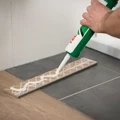
Piping should be laid in advance. PVC should be roughened very well to ensure good adhesion with the polyester. So sand the PVC well with 60-grit sandpaper. Piping fitted afterwards can be glued in with Tec7 adhesive sealant.
Filter box
Filter boxes and quarantine boxes can also be made of polyester and fiberglass mat. The base can be made of wood and then covered with polyester laminate. Used containers can be repaired or modified with polyester and fiberglass.
Protect the building site from sun and rain
Polyester should not be applied in full sun, but in the shade. The construction site should also be protected from rain. If the weather is not reliable enough, provide the construction site with a tent, tarpaulin or canopy. This can be done, for example, with scaffold tubes and one or more tarpaulins or with a lightweight version of bent PVC pipe and white sheeting.
Required materials for the construction of a polyester pond
You need different materials to make a pond. The required materials are briefly explained below.
Polyester primer
RESION polyester primer serves to make the covering adhere to the substrate and to protect the polyester from substances that may come from concrete or cement. The consumption of RESION polyester primer is approximately 200-300 gr/m2.
Fibreglass chopped strand mat
Fibreglass chopped strand mat forms the strong lining layer that waterproofs your pond. Fibreglass mat is used in combination with met polyester resin. The more layers of fibreglass mat are applied, the stronger the final result. For lining a masonry or concrete substrate, we recommend at least 2 layers of 450 g/m2 fibreglass mat . For ponds made on a (lost) material such as wood, jute, in stable soil or on an old foil pond, we recommend 4-6 layers of fibreglass mat, depending on the size of the pond.
Polyester laminating resin
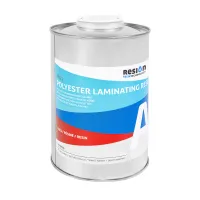
Polyester laminating resin is used to form a durable covering, in combination with glass fabric. Consumption: every 1 m2 of 450 g/m2 glass mat requires 1 kg of polyester resin to be processed correctly.
Polyester topcoat
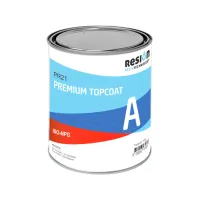
Polyester topcoat is necessary to colorize the pond, after lamination. This topcoat forms a thick protective layer that protects the fibreglass from influences of water and chemicals and forms a smooth layer. The consumption of polyester topcoat is approx. 300-400 gr/m2.
Personal protective equipment
While working with polyester, it is very important to work safely, as polyester can be harmful to your health if you do not use the right protective equipment. We therefore always recommend using the following personal protective equipment:
- Nitrile or Latex gloves
- Safety glasses
- Half mask respirator
- Disposable overall
Auxiliary materials
To process polyester, a number of auxiliary materials are required. Think of brushes, rollers, mixing cups, etc. With a auxiliary materials kit for Polyester, you have the most important auxiliaries at an affordable price.
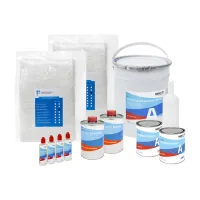
For a number of pond sizes (5m2, 10m2, 20m2, 50m2, 100m2), we have created ready-made polyester pond kits with everything you need to cover a concrete or masonry pond with 2 layers of glass mat and 1 layer of polyester topcoat.
Laminating a polyester pond
The container must be clean. Plan the work in advance and prepare the materials. Start with the walls and then the bottom. Let the bottom rise 10 cm against the walls.
Tear the glass mat into manageable pieces of, for example, 1 meter. By tearing the glass mat, possibly along a slat, you can conceal the transitions invisibly.
Step 1. Applying adhesive primer
First of all, apply RESION polyester primer. This is a 1-component primer that can be applied with a roller and brush. Pour the required amount of primer into a roller can and apply. Close the container tightly again, otherwise the primer will already harden in the can.
Depending on the circumstances, this primer will be sufficiently hardened after 30 minutes to 2 hours, so that you can continue with the polyester. For optimal adhesion, you should apply the polyester within 12 hours after applying the adhesive primer. So only apply primer to the part that you can laminate that day.
Step 2. Applying the glass mat with polyester resin in the pond
To apply glass mat with polyester resin, proceed as follows:
- Mix polyester resin with hardener. Use approx. 2% hardener. So for every kilo of polyester resin you use approximately 20 ml of hardener.
- Wet the surface with polyester resin. This can be done by casting and rolling or just rolling. Only wet what you can laminate in the next 10 minutes. Start with approximately 1 m2, so that you gain experience in laminating and the speed at which you can do it. For 1 m2 of glass mat you need approximately 1 kg of polyester resin.
- Place the mat in the wet resin and wet it, this can be done with the fleece roller. The mat will become smooth and transparent. Use the flexibility of the mat to fold and shape difficult parts. If there are still white spots, more resin should be applied there. Avoid shiny spots, the structure of the mat must remain visible.
- Now de-aerate the laminated section with a de-aerator roller. This will cause the laminate to become slightly darker in color, so you can see where you left off. Deaerate the laminate accurately, this is a very important part of the process. Venting should be done immediately after applying the resin and while it is still wet. So laminate a small piece each time and then vent it. Or have someone else bleed the laminate. After bleeding, rinse the bleeding roller in a container of acetone.
- A second layer can be laminated immediately after the first layer (wet on wet). Vent this layer well again. It is a good idea to stagger the seams of the first and second layers at least 6 inches.
In this way, you cover the entire pond. If you need to overlap a piece of polyester that has already been cured for more than 4 hours, sand it coarsely with 60-grit sandpaper.
Step 3. Finishing the polyester pond with polyester topcoat
Now lightly sand the cured polyester with 60-grit sandpaper. This also removes any raised fibers. If any areas that require repairs come to light during sanding, such as large air inclusions, do so now. Sand open the air pocket and apply a new layer of laminate.
If everything is in order, apply a layer of polyester topcoat. This top coat can be applied with a roller. Use sufficient hardener (2.5-3% at 15°C, 2-2.5% at 20°C, 1.5-2% at 25°C). Apply the topcoat sufficiently thickly, approximately 350-400 gr/m2, in 1 layer. To control this, prepare 1 kg of topcoat at a time and apply it to approximately 2.5 m2 of laminate.
The topcoat has hardened sufficiently after approximately 2 hours to be able to walk on it. Now check the top coat for any sharp edges or the like. This is now easy to update.
Then let the top coat harden for at least 48 hours. Make sure that no water gets on the topcoat during this time, as this can cause discoloration.
After 48 hours the pond can be filled and put into use.
Frequently asked questions about the construction of a polyester pond
I would like to know how many materials I need...
If you tell us the dimensions of your pond, we will draw up an overview of the materials you need. We take into account small losses for resin and glass mat and also calculate the correct amount of hardener, auxiliary materials and protective equipment. You will receive a complete package, where you can be sure that you have everything you need to build the pond. This quote is completely without obligation and have you ordered too much? You can return unopened packages for free!
My polyester or topcoat remains sticky...
Then a few things could have gone wrong: for example, was it warm enough (at least 15°C)? If not, you should wait longer or try to warm the whole thing up a bit. If you have added too little hardener, you can try the same. Did you forget the hardener? Then you have no choice but to take everything out and start over.
My topcoat turns white when water gets on it...
In that case the topcoat has not hardened sufficiently. Wait longer, apply a thicker layer, at a higher temperature and/or with more hardener. This will make the top coat harden better, making it water resistant.
If you have any other questions, you can of course contact us. Our specialists are happy to help you with your project!