Often chosen

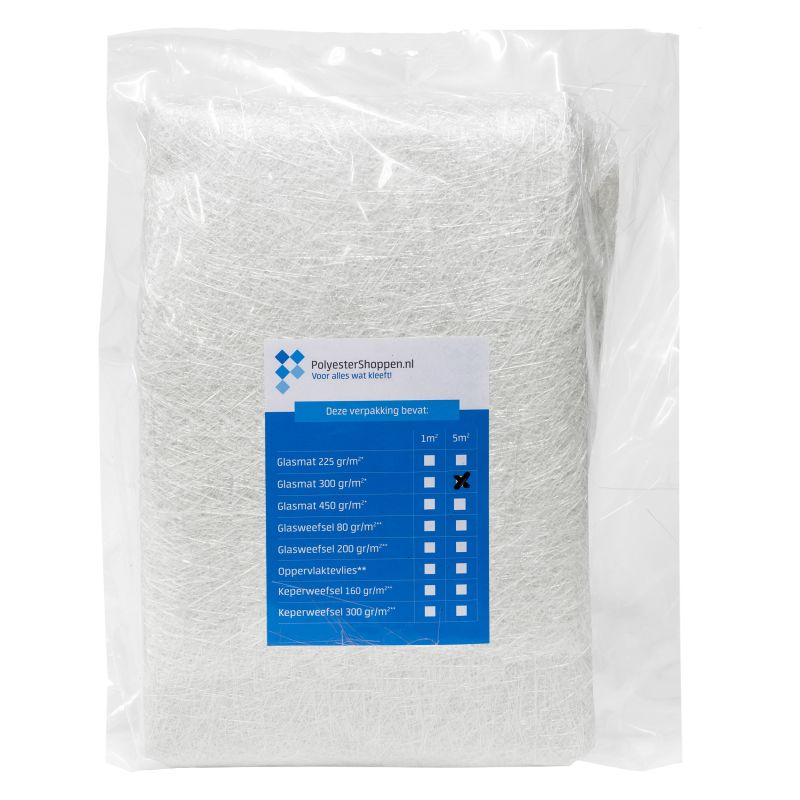
Fibreglass chopped strand mat is the most commonly used reinforcement material for making laminates with the "hand lay-up" technique. The glass fibres are cross-linked and are held together by a binder. This binder dissolves in styrene (e.g. polyester resin) and can therefore take on many different shapes during lamination.
Fibreglass chopped strand mat 300 gr/m2 is used for molded parts with many details.
Surface weight: 300 gr/m2
Thickness: approx. 0.7 mm
Width: 100 cm
Comaptible with: polyester resin and vinylester resin
Packaging: 1 m2, 5 m2, 20 m2, and approx. 120 m2 (roll-packed)
Resin consumption per layer (polyester):
| 1 m2 300 gr/m2 | 0.7 kg polyester |
| 5 m2 300 gr/m2 | 3.5 kg polyester |
| 20 m2 300 gr/m2 | 14 kg polyester |
| 150 m2 300 gr/m2 | 100 kg polyester |
The key technical properties clearly listed in one place.
The materials, substrates or tasks a product is intended for. A general claim such as 'suitable for plastics' does not mean it works with every type of plastic; the specific substrate and its preparation still matter.
Fabric or reinforcement type describes how the fibres are arranged. This affects how easily the material drapes over a shape and which directions it mainly reinforces.
Note: a Square reinforcement (0°/90°) is not the same as a plain-woven square fabric. Also consider fibre type and areal weight (g/m²).
The technical product category, such as primer, resin, hardener or cleaner. It explains the product's purpose and helps you find other products with a similar function.
The measurement across a product from one side to the other, for example for rolls, panels or fabrics. With rolled materials, the usable width may differ from the overall width.
The physical thickness of the supplied material, such as a panel, pad, film or foam sheet. This differs from the thickness of a liquid coating applied to a surface.
Areal weight is the weight of one square metre of dry reinforcement, expressed in g/m² (grams per square metre). For example, 200 g/m² glass fabric contains 200 grams of dry fibres per m², without resin. Areal weight helps with reinforcement selection and resin consumption estimates, but it is not the final laminate thickness.
Useful additions for your project.