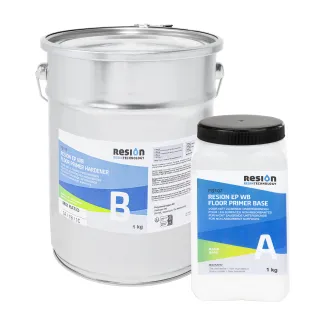
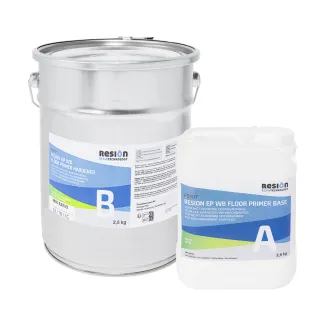
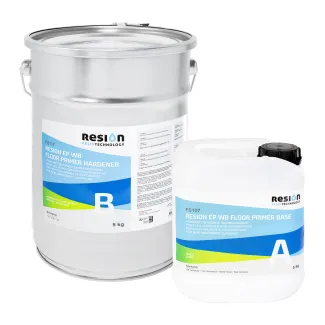
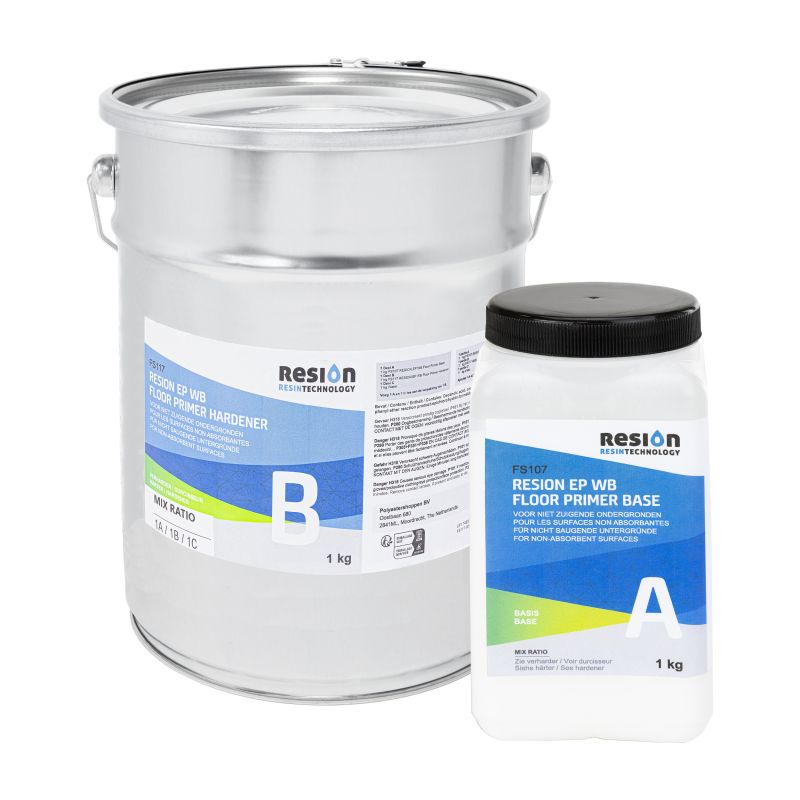
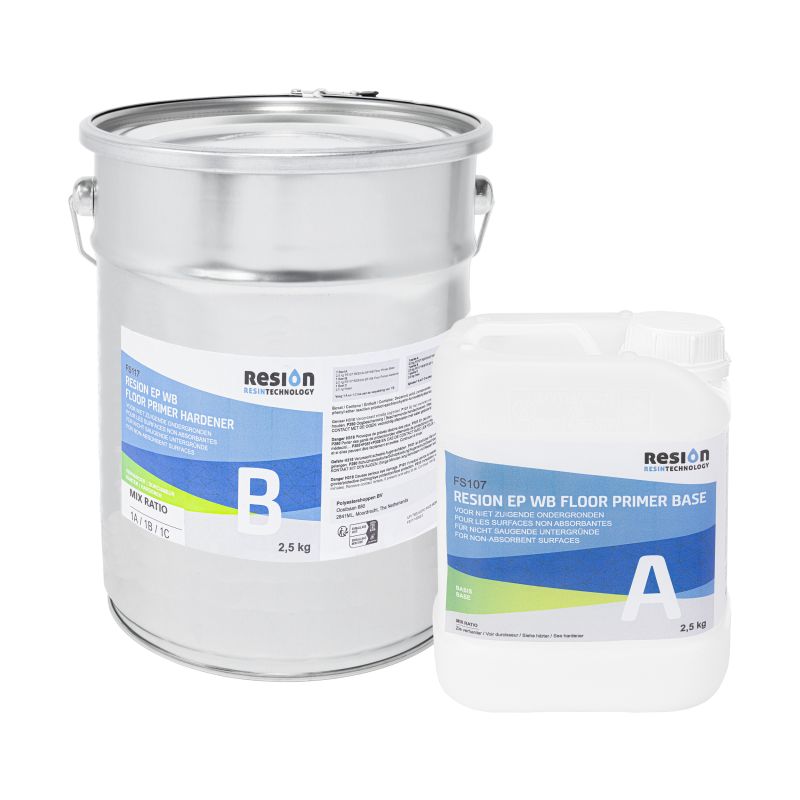
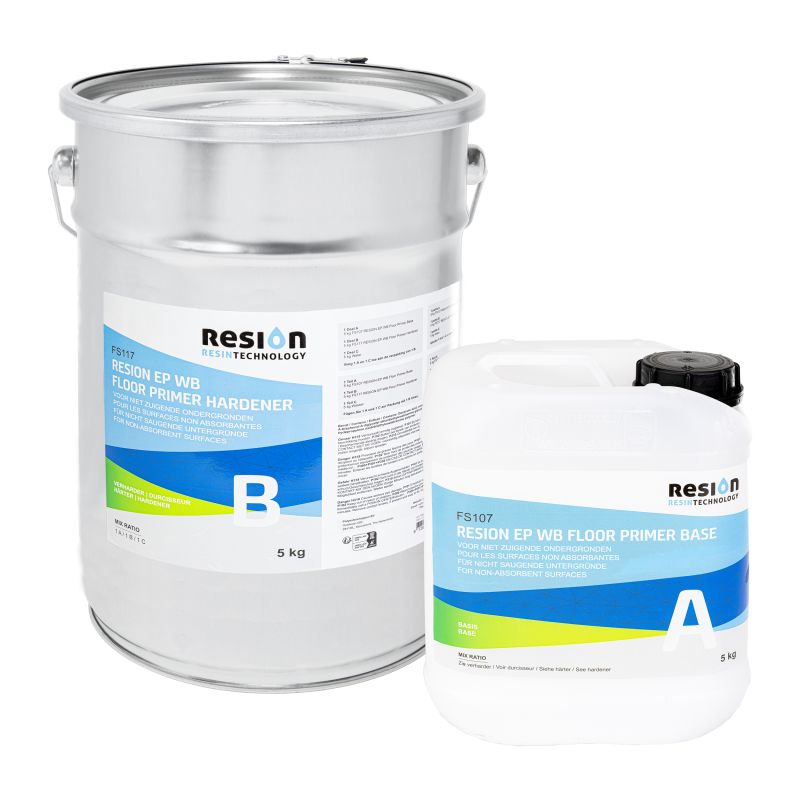

FS107 | EP Floor Primer WB (watergedragen vloerprimer) | Base | 1kg
UFI: 62E0-Q08Y-C00X-72AF
RESION Epoxy Floor Primer WB is a fast-drying primer with excellent adhesion to non-porous substrates such as power-floated concrete, tiles, or existing epoxy and polyurethane resin floors and coatings. This water-based epoxy floor primer is dust-dry after 6 hours, offers high coverage, and is also suitable for slightly damp substrates.
Are you looking for a fast-drying primer so you can quickly continue with your self-levelling floor or floor coating? Choose RESION Epoxy Floor Primer (WB) for non-porous substrates!
The universal RESION Epoxy Floor Primer WB is suitable for use on non-absorbent to slightly absorbent substrates. This makes the floor primer suitable for use on dry and smooth substrates such as:
The water-based epoxy floor primer is easy to apply. Before applying the primer, it is important to properly prepare the substrate. We recommend grinding concrete floors with a diamond disc. You can roughen tiled floors with a PKD disc.
Follow the steps below to properly apply the epoxy floor primer:
For questions about surface preparation or application of RESION Epoxy Floor Primer WB, please contact our product specialists. For more information about this primer, please refer to the technical documentation.
| Packaging | Coverage | Base (FS107) | Hardener (FS117) |
| Set of 2 kg | 16 m2 | 1 kg | 1 kg |
| Set of 5 kg | 40 m2 | 2.5 kg | 2.5 kg |
| Set of 10 kg | 80 m2 | 5 kg | 5 kg |
Looking for a floor primer for your epoxy floor? Order your primer easily at Polyestershoppen.com. We will ship your order as quickly as possible. Do you still have questions? Our customer service team is ready to help you! You can reach us by phone at +31 (0)85 022 0090 or by email at support@polyestershoppen.com. We will be happy to assist you!
The key technical properties clearly listed in one place.
The technical product category, such as primer, resin, hardener or cleaner. It explains the product's purpose and helps you find other products with a similar function.
The resin family or system that a hardener, additive or reinforcement material can be combined with, such as epoxy, polyester or vinyl ester. Compatibility depends on the complete system, not just the general resin type.
The period for which an unopened product remains usable under the specified storage conditions. Check whether the period starts from the manufacturing date or another date. Shelf life may be shorter after opening, especially for products sensitive to air or moisture.
Mixing ratio indicates how much of each component is needed, for example resin (A) and hardener (B). A ratio of 100:50 by weight means 100 grams of A to 50 grams of B; by volume you might use millilitres. Weight and volume ratios are not necessarily the same because the components may have different densities. Accurate measuring is important for proper curing.
A solvent-free product contains no added solvents according to the manufacturer's specification. This does not automatically mean it is odourless, emission-free or safe to use without protective measures.
Curing time is the period a product needs to reach a specified stage of cure. It is usually given in hours or days, often at a reference temperature such as 20 °C. A product may be tack-free or safe to handle before reaching its full mechanical and chemical resistance. Film thickness and mixed quantity may also affect the time.
Consumption or coverage describes how much product is needed for a given surface area. Consumption may be stated in g/m² or kg/m², while coverage is often given in m²/L or m²/kg. A consumption of 0.2 kg/m² means a theoretical 200 grams per square metre. Actual use depends on film thickness, substrate absorbency, application method and waste.
A specific thinner that can be used, where permitted, to adjust a product's application properties or viscosity. The correct thinner and maximum quantity depend on the product. Incorrect thinning can affect coverage, drying and curing.
Working time is the period during which a product remains workable after mixing or activation, usually given in minutes at a specified temperature, often 20 °C. With reactive resins, the chemical reaction also continues in the mixing container, and larger quantities or higher temperatures can shorten this time. Working time is different from gel time and full curing time.
The waiting time before a coating, floor or bonded joint can withstand a specified load, such as light foot traffic or gentle handling. Resistance often increases as curing continues; full mechanical and chemical resistance may be reached later.
The conditions under which a product best retains its quality, including temperature, humidity and protection from direct sunlight. Keeping containers tightly closed is particularly important for moisture-sensitive or volatile products.
Read the warnings and use appropriate protective equipment before handling the product.
UFI: 62E0-Q08Y-C00X-72AF
UFI: T4E0-60YC-P00E-WDWH
Useful additions for your project.