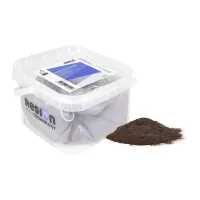
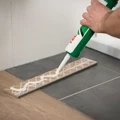
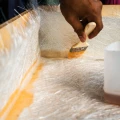
Although polyester and epoxy resins are naturally low-viscosity, it can sometimes be useful to thicken them with fillers for various applications. This is easily done by adding fillers to the resin. But which filler should you use, for example, to make a putty? In this article, we discuss several commonly used combinations.
At Polyestershoppen, you can find a variety of fillers and resin systems such as epoxy and polyester resin. All products are shipped directly from stock!
The basics of resin and fillers
Creating a resin/filler mixture is done in two steps:
- First, mix the resin (epoxy or polyester resin) with the corresponding hardener according to the instructions.
-
Then, gradually add the filler in small amounts and mix until you achieve the desired consistency.
Since the ideal mixing ratio depends on factors such as temperature and type of application, there are no fixed proportions. Use your eyes and hands to judge the thickness.
Determining consistency: from syrop to peanut butter
When describing the thickness of a resin/filler mixture, the following terms are commonly used worldwide:
Syrop
- Properties: an unthickened resin with no fillers. Drips easily from vertical surfaces.
-
Applications: for impregnating surfaces and saturating fibreglass or other fabrics.
Ketchup
- Properties: a slightly thickened resin with a small amount of filler. Still runs on vertical surfaces.
-
Applications: bonding large surfaces, well-fitting wood joints, or for injection with a syringe.
Mayonnaise
- Properties: a thickened resin with peaks that collapse. Adheres well to vertical surfaces.
-
Applications: bonding, making fillets, filling joints, and working with poorly fitting wood joints.
Pindakaas
- Properties: a very thickened resin with peaks that hold their shape.
-
Applications: filling holes, making putty, and bonding uneven surfaces.
Combining fillers with resins
1. Bonding wood:
Combination: Epoxy + cotton fibres
For bonding wood, epoxy resin thickened with cotton fibres is an excellent choice. Make sure the mixture is not too thick. For joints that fit well together, a ketchup-like consistency is sufficient. In this consistency, the mixture can still be easily applied with a brush. For filling larger gaps or uneven surfaces, the resin can be thickened to a mayonnaise-like consistency.
2. Making strong fillets:
Combination: Epoxy + stewathix
For strong fillet joints, Stewathix combined with epoxy is recommended. This filler is easy to mix, non-dusting, and produces a solid result. Experienced users will note that Stewathix has largely replaced Aerosil/Silica, mainly for health reasons. For fillets, a minimum mayonnaise consistency is required. For extra strength or larger applications, a peanut butter-like consistency is needed. Ensure the mixture is not too thin to prevent sagging and achieve a smooth finish.
3. Making a lightweight fillet:
Combination: Epoxy + red microballoons
For lightweight constructions such as boat interiors or drawers, a lightweight fillet is ideal. Use red microballoons to thicken the epoxy to mayonnaise consistency. For easier handling, add a small amount of Stewathix. Ensure the entire mixing cup has an even consistency. Due to the light nature of the microballoons, the bottom of the mixture may sometimes remain slightly thin. Mix carefully, including vertically, for a proper fillet.
4. Making putty:
Combination: Epoxy + red microballoons
Epoxy putty can be expensive, but using red microballoons allows you to create a more cost-effective alternative. This combination produces a sandable epoxy putty. Thicken the epoxy to a peanut butter-like paste and apply it to a coarsely sanded surface (grit P40-120).
More information about fillers
Do you have questions about combining fillers with resin systems? Feel free to contact our specialists for tailored advice via support@polyestershoppen.com or WhatsApp!