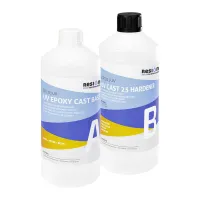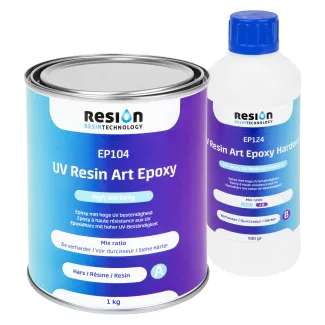
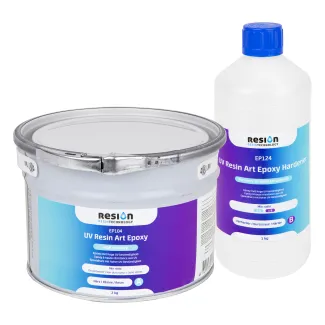
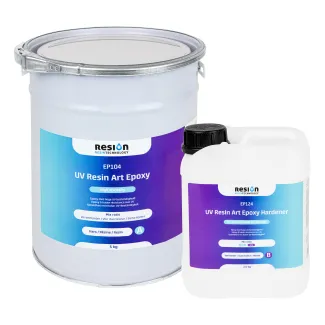
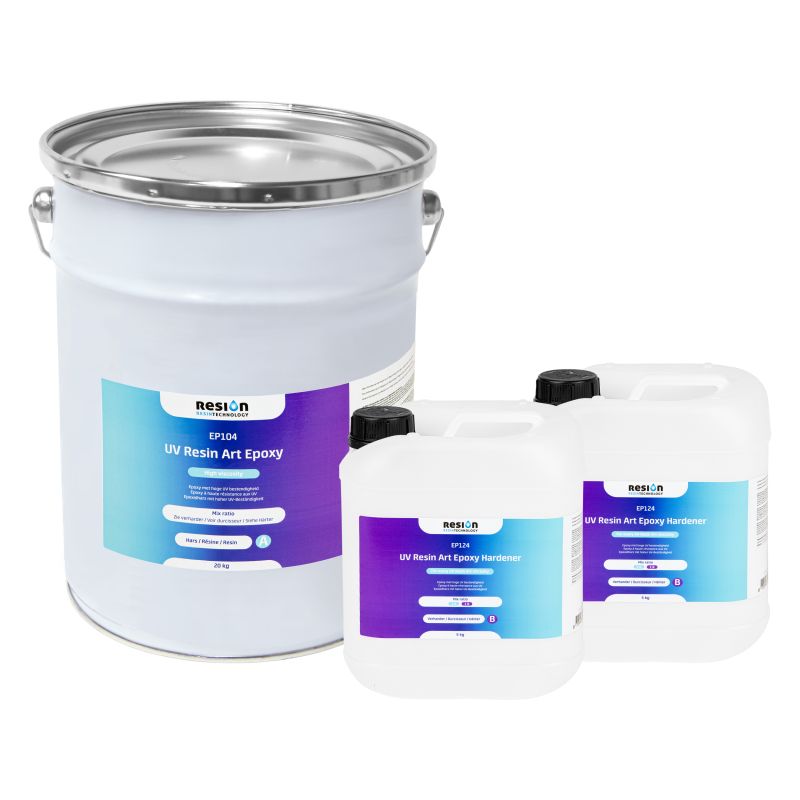

RESION UV Resin Art Epoxy HV
At a glance
- High viscosity
- UV stabilised
- 2:1 mixing ratio
- Suitable for making geodes etc.
With RESION UV Resin Art Epoxy HV, you can create beautiful Resin Art works. The epoxy has a very high viscosity and will therefore flow out very thickly, in terms of viscosity it is similar to RESION food-safe epoxy. The high viscosity makes the epoxy resin extremely suitable for making art where it is important that the epoxy stays where you apply it. For example, you can use RESION UV Resin Art Epoxy HV very well for making geodes and projects where you don't want different colours to mix.
The highly viscous epoxy is very UV stable and is easy to process with the 2:1 mixing ratio. So are you looking for a high-quality, high-viscosity epoxy? Then RESION UV Resin Art Epoxy HV is the resin you are looking for!
Benefits of Resin Art Epoxy HV
- High quality transparent epoxy.
- Very high UV resistance.
- Adheres to almost all surfaces (like wood, concrete and plasics).
- Easy in use due to the 2:1 mixing ratio.
- High viscosity (very thick flow).
- Odourless.
High viscosity
This resin art epoxy has a high viscosity so the epoxy resin flows very thick. Due to the high viscosity the resin remains well in place and is very suitable for making geodes and paintings. The pigments flow slow so you can make different zones in your artwork.
UV resistant epoxy
We have extensively tested the UV Resin Art Epoxy for UV stability by testing the resin for a longer period in a special UV cabinet. This way we can guarantee that this epoxy casting resin is very resistant to UV radiation and will therefore not yellow. You do not need a UV stabilizer for this resin! The high UV stability also makes the Art Epoxy ideal for applications that will be exposed to a lot of sunlight, such as tables and jewellery.
Directions for use
Using RESION Art Epoxy is very simple if you follow the following steps:
- Weigh the base component (A) and the hardener (B) well according to the mixing ratio stated on the packaging (2 parts by weight of resin to 1 part by weight of hardener).
- Mix the base and hardener thoroughly for 3 minutes. Also scrape well along the side and bottom of the mixing cup!
- If desired, add pigments to colour the resin.
- Then apply the epoxy to the surface you will use (the pot life is 30-60 minutes at 20℃).
- After application, allow the Art Epoxy to cure for approximately 12-18 hours before it is manageable (note: after 3-5 days the epoxy will not be fully cured).
Packaging
| Unit | Resin (EP 104) | Hardener (EP 124) |
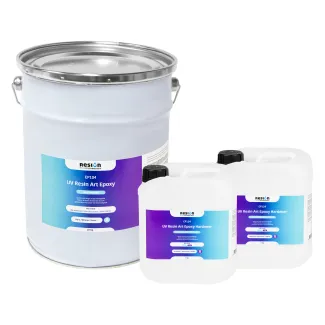
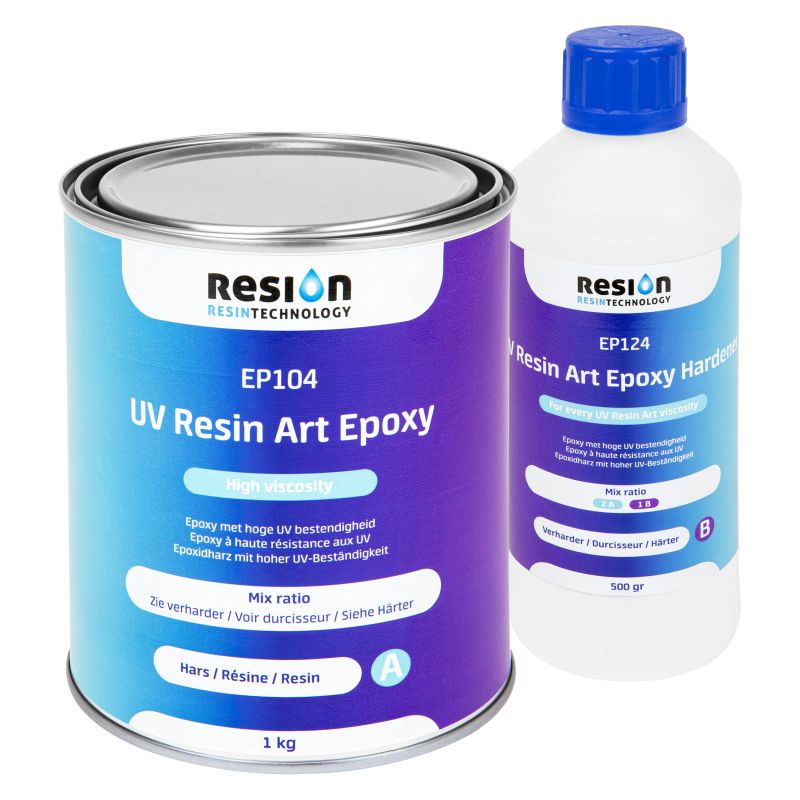
| 1.5 kg | 1 kg | 0.5 kg |
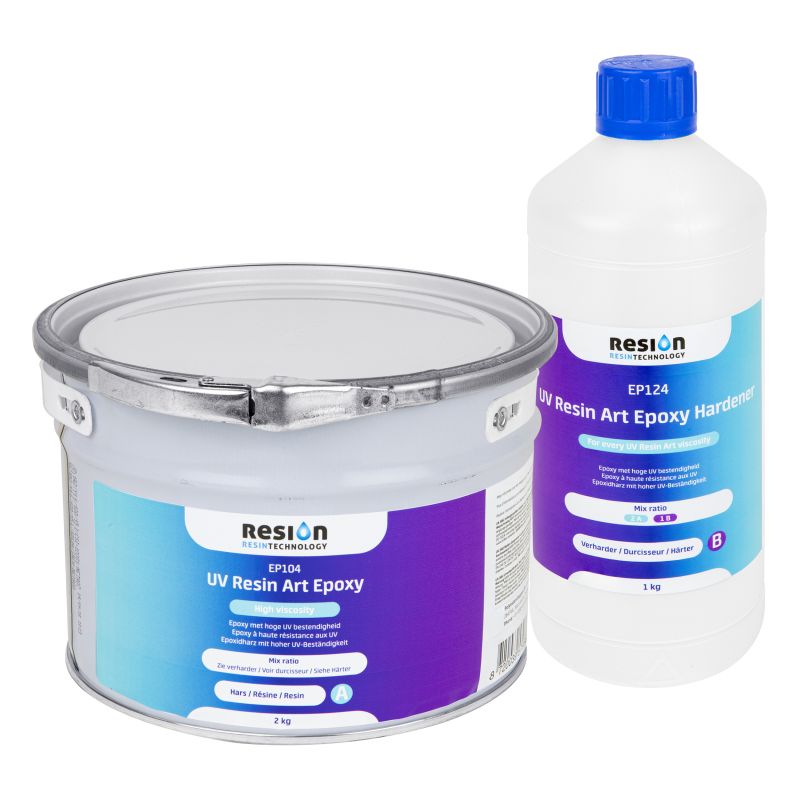
| 3 kg | 2 kg | 1 kg |
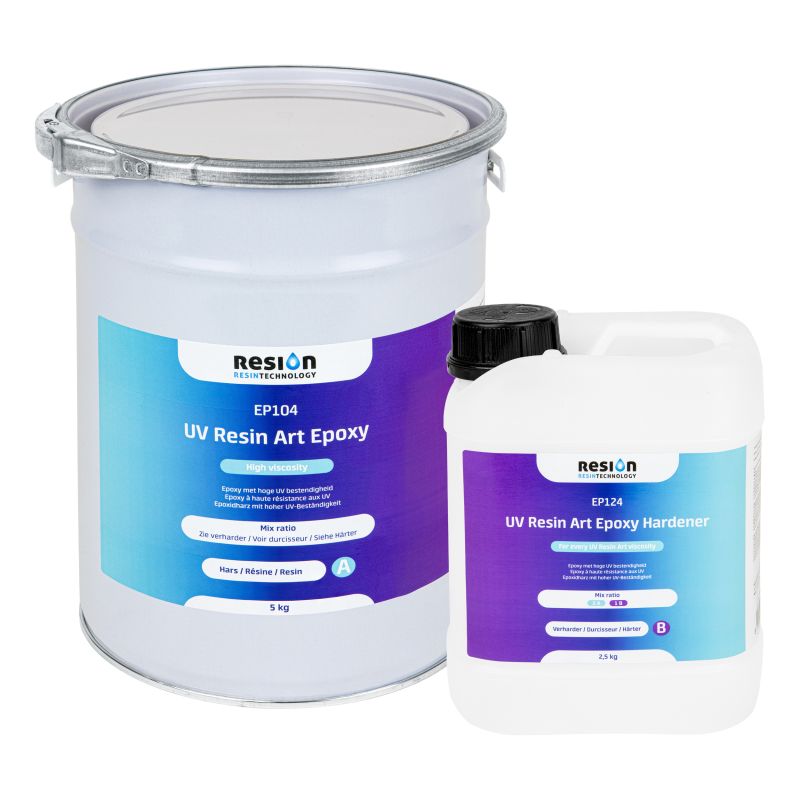
| 7.5 kg | 5 kg | 2.5 kg |
| 30 kg | 20 kg | 10 kg |
More information?
You can easily order RESION UV Resin Art Epoxy HV at Polyestershoppen.com. If you order on working days before 5:00 pm CET (Central European Time), the high viscous UV epoxy will be shipped the same day! Also view our other Resin Art products. Would you like more information about RESION UV Resin Art Epoxy HV? We are happy to advise. Please contact us by calling +31850220090, via email support@polyestershoppen.com or via our live chat.
Product properties
The key technical properties clearly listed in one place.
- Article number
- EPO000976
-
The technical product category, such as primer, resin, hardener or cleaner. It explains the product's purpose and helps you find other products with a similar function.
- Epoxy system
-
Mixing ratio indicates how much of each component is needed, for example resin (A) and hardener (B). A ratio of 100:50 by weight means 100 grams of A to 50 grams of B; by volume you might use millilitres. Weight and volume ratios are not necessarily the same because the components may have different densities. Accurate measuring is important for proper curing.
- 2:1 (by weight)
-
UV stabilisation helps a material better withstand the effects of sunlight, including yellowing and deterioration of its properties. It slows ageing but does not make a resin or plastic completely resistant to UV exposure. The degree of protection varies by product.
- Yes
-
The tasks a product is intended for, such as laminating, casting, bonding, sealing or protecting. Products intended for the same application can differ considerably in processing, curing time and final properties.
- Casting
- Colour
- Crystal clear
-
Working time is the period during which a product remains workable after mixing or activation, usually given in minutes at a specified temperature, often 20 °C. With reactive resins, the chemical reaction also continues in the mixing container, and larger quantities or higher temperatures can shorten this time. Working time is different from gel time and full curing time.
- Approximately 30-60 minutes (at 20 °C)
-
At this point, the material is generally firm enough to handle carefully, move or remove from a mould. Sanding, heavier loads or extended use may require further curing.
- 12-18 hours (20 °C)
-
Minimum application temperature is the lowest temperature at which a product may be used according to the manufacturer. The limit can apply to the air, substrate and product itself.
At lower temperatures, resins and coatings can become thicker and cure more slowly. Moisture can also condense on a cold substrate and reduce adhesion. Check the dew point and measure the surface temperature before starting. A longer drying time does not automatically make application below the specified minimum acceptable.
- 15 °C
-
A paint or varnish layer is dust-dry when settling dust is less likely to stick to the surface. It may not yet be touch-dry, ready for overcoating or suitable for loading; these are different stages of drying and curing.
- 6-12 hours (20 °C)
-
Curing time is the period a product needs to reach a specified stage of cure. It is usually given in hours or days, often at a reference temperature such as 20 °C. A product may be tack-free or safe to handle before reaching its full mechanical and chemical resistance. Film thickness and mixed quantity may also affect the time.
- 3-5 days
- Net contents
- 1.5 kg, 30 kg, 3 kg, 7.5 kg
-
Viscosity measures how easily a liquid flows, or how thick it is. Dynamic viscosity is usually expressed in mPa·s (millipascal-seconds), sometimes in cP (centipoise); 1 mPa·s = 1 cP. A lower value usually means a more free-flowing liquid, while a higher value indicates a thicker product. Temperature and test method strongly affect the value. Note that mPa·s is different from MPa, which is used to express mechanical strength.
- Very high (approximately 12.000 mPa·s)
-
Heat resistance describes the temperature a material can withstand after correct processing and curing, usually expressed in degrees Celsius (°C). Continuous exposure is different from a brief temperature peak, and mechanical loading may also affect the limit. Heat resistance is not the same as the temperature at which the product can be applied.
- 40 to 45 °C
Safety information
Read the warnings and use appropriate protective equipment before handling the product.
EP124 | UV Resin Art Epoxy | Verharder (B) | 0,5 kg
UFI: FH00-T0H0-N00P-N781
Recommended protective equipment
Hazard pictograms
Warnings and precautions
Reviews
Frequently bought together
Useful additions for your project.