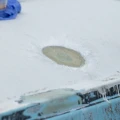
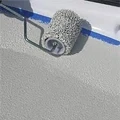
You take your boat out of winter storage and the shine is clearly gone. The colour looks faded, the hull feels rough or powdery, and when you run your finger across it a white haze is left behind. This is not just dirt that will wash off. This is oxidation, also known as chalking, and it is one of the most common problems with fibreglass boats.
The good news: oxidation is almost always repairable. How much work it takes depends on how deep the damage goes, but in most cases compound, polish and wax will get you a long way. In this article we explain what oxidation is, how to recognise it and how to fix it, from mild to severe. That way you can achieve the best possible boat maintenance results.
What exactly is gelcoat oxidation?
Gelcoat is the outermost protective layer of a fibreglass boat. It gives the boat its colour, gloss and protection against moisture and UV radiation. But that UV radiation is also gelcoat's biggest enemy. Years of exposure to sunlight slowly breaks down the resin bonds in the top micro-layer of the gelcoat. The result is a dull, rough, powdery surface that has lost its gloss and colour depth.
This process is called oxidation or chalking in trade terms, and it is not unique to boats. You see the same thing on old cars, caravans and other painted outdoor surfaces that have been in the sun for years. The difference with a car is that boat gelcoat is thicker and harder, and therefore more often repairable, even when the damage is already quite advanced.
How do you recognise chalking and oxidation?
There are a few simple tests to assess how severe the oxidation is. Wipe a dry, dark cloth or your finger across the surface. If a white or grey haze is left behind, you have chalking. The more material that comes off, the more advanced the oxidation.
Also look at the colour in the shade versus in direct sunlight. Oxidised gelcoat often already looks flat and dull in the shade, and this becomes even more obvious in the sun. On dark colours, navy blue or bright red, oxidation shows up more clearly than on white gelcoat, but it occurs with all colours.
Finally, run your fingernail across the surface. Lightly oxidised gelcoat feels slightly rough or dull but is still intact. Heavily oxidised gelcoat feels powdery, gritty or even dry to the touch. In that case the top layer has largely broken down and you will need to go deeper to restore the damage.
Mild oxidation: polishing and waxing is enough
With mild oxidation, where there is a visible haze but the colour is still reasonably preserved, a good polish followed by a wax or sealant is sufficient. A fine marine polish removes the damaged top layer, evens out the surface and restores the gloss. Then apply a coat of wax or polymer sealer to protect the gelcoat and maintain the shine.
Always work in small sections of half a square metre or less, so the polish does not dry out before you buff it off. Do this in the shade or on a cloudy day, because in direct sunlight polish dries far too quickly. After waxing you are done for the season, provided you rinse the boat regularly and wax it annually.
Moderate oxidation: compound first, then polish
When oxidation is more advanced, the colour is clearly faded or a thick haze comes off, polish alone is not enough. You will need a compound. Compound is coarser than polish and abrades a thin layer of the gelcoat away so you reach fresh, unoxidised material. After that you follow up with a fine polish to remove the compound scratches, and finish with wax.
Use compound by hand on small surfaces, or work with a dual-action polisher on larger areas. The machine is faster and more consistent, but be careful on corners, ridges and edges: the gelcoat is thinner there and you can cut through it faster than you expect. Use a medium-soft pad for compound and a soft pad for polish.
Severe oxidation: wet sanding as the first step
With severe oxidation, where the gelcoat is completely dull and chalky and barely responds to compound, wet sanding or abrading the hull is the most effective approach. You use waterproof abrasive paper in a fine grit, starting with grit 400 or 600, and wet-sand the damaged surface away. Then work through progressively finer grits towards 1000 or 1200 until the surface feels smooth and even.
After wet sanding you still follow up with compound and polish to remove the sanding marks and restore the gloss. Finish here too with wax or sealant for protection. Wet sanding sounds drastic, but on heavily oxidised gelcoat it is the only way to achieve a truly beautiful result. Note: only do this if the gelcoat still has sufficient thickness. On very thin or damaged gelcoat it is better to opt for a coating solution.
When is the gelcoat too far gone?
There is a point where polishing and compound no longer help, namely when the gelcoat is so thin or dry that dry spots or translucent patches remain visible even after working it up. In that case the gelcoat has locally worn through its own thickness and you need to repair or recoat.
Small damage can be filled with gelcoat repair paste. Larger or multiple affected areas can be overcoated with gelcoat spray or a two-component topcoat. That is more work, but the result is more durable than continuing to polish something that has simply run out.
How to prevent oxidation from coming back
The best way to limit oxidation is to wax regularly, at least twice a year: once before the season and once at the end, before the boat goes into storage. Wax forms a protective layer that keeps UV radiation and dirt out and slows down oxidation.
Store your boat preferably under a cover or in covered storage. A boat that stands outside all year round, even in winter in direct sunlight, oxidises much faster than a boat that is stored under cover. And rinse the hull regularly with clean water to remove salt, bird droppings and other deposits that attack the surface.
What products do you need?
At Polyestershoppen you will find everything for restoring and protecting your gelcoat. Choose a marine compound for moderate to severe oxidation, a fine marine polish for the finishing step, and a carnauba wax or polymer sealer for the protective final coat. For wet sanding you need waterproof abrasive paper in multiple grit sizes. Browse our range of Riwax, Dulon and our own RESION line for boat maintenance. Not sure which product is right for your situation? Send us a photo via WhatsApp and we will give you direct advice.